How Other People’s Unspoken Expectations Control Us

We quickly sense how others view us and play up to these expectations.

remote

We quickly sense how others view us and play up to these expectations.

A good exercise for learning about yourself is to think about how other people might view you in different ways. Consider how your family, your work colleagues or your partner think of you.

Continue reading “How Other People’s Unspoken Expectations Control Us”

The Acceptance Prophecy: How You Control Who Likes You

Is interpersonal attraction a self-fulfilling prophecy?

The mystical-sounding ‘acceptance prophecy’ is simply this: when we think other people are going to like us, we behave more warmly towards them and consequently they like us more. When we think other people aren’t going to like us, we behave more coldly and they don’t like us as much.

It’s a self-fulfilling prophecy because if we predict acceptance we get it, if not we don’t. It’s also an intuitively appealing explanation for how people come to like (or dislike) each other. But the question for psychologists is whether it is really true or just a neat fairy story.

The waters are, of course, muddied by all the usual individual and cultural differences—some people care more about other’s acceptance and some people are naturally more accepting—but let’s set those aside for a moment and just imagine two people who are identical except that one expects others to accept her and one expects others to reject her.

What the research has found, according to a new paper just published in Personality and Social Psychology Bulletin, is that one part of the acceptance prophecy has strong evidence to support it, while the other part does not. Until now.

The first part, in a model put forward by Dr Danu Anthony Stinson at the University of Waterloo and colleagues, is that the interpersonal warmth people project predicts how much others like them (Stinson et al., 2009). For psychologists this is uncontroversial; people take better to others who are genuinely warm with accurate judgements about their warmth made in only 30 seconds (Ambady et al., 2000).

Pleased to meet you

What has proved more controversial is whether anticipating acceptance really does increase the interpersonal warmth that people project towards others. It’s this question that Stinson et al. (2009) set out to test by manipulated people’s expectations about a person they were about to meet for the first time.

They told 14 of 28 men recruited for their study that the attractive woman they were going to meet was nervous and worried about how she would be perceived by them. Quite naturally when these men found that the woman was nervous and insecure it made them feel better in comparison. This had the effect of making the men much less anxious about the interaction (actually about half as nervous as judged by independent observers) and consequently much warmer.

In comparison the other 14 sweaty-palmed participants were only given basic demographic information about the woman they were going to talk to, nothing that would calm their fears of rejection. This manipulation created two groups, then, one that was anticipating acceptance more than the other.

What the results showed was that when the risk of rejection was lower, men acted more warmly towards the woman to whom they were talking. This extra warmth also lead to a panel of observers liking them more in comparison with those who were more fearful of risk and therefore interpersonally colder.

So this provides evidence that the acceptance prophecy holds true. In this experiment people who expected to be accepted did act more warmly towards a stranger and consequently they were perceived as more likeable.

Social optimist or pessimist?

There was an exception, though, to the results of this study. One sub-group were not affected by the experimental manipulation to increase how much they expected to be accepted. That’s because they already expected to be accepted. These are the social optimists (or at least people who think rather a lot of themselves!).

Social optimists, of course, are in the happy position of expecting to be accepted and finding that, generally speaking, they are. Social pessimists, though, face the dark side of what sociologist Robert K. Merton—who coined the expression ‘self-fulfilling prophecy’—has called a ‘reign of error’. Expectation of rejection leads to the projection of colder, more defensive behaviour towards others, and this leads to actual rejection. “Uh-huh,” mutters the social pessimist, “I knew they wouldn’t like me”.

And so it goes.

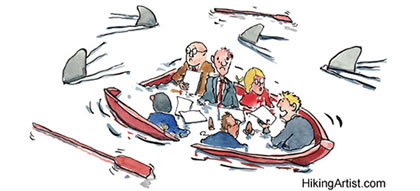
Why Groups Fail to Share Information Effectively

When asked to make a group decision, instead of sharing vital information known only to themselves, people tend to repeat information that everyone already knows.

sharks_meeting

“No, leaks aren’t on the agenda…”

In 1985 Stasser and Titus published the best sort of psychology study. Not only does it shine a new light on how groups communicate and make decisions, it also surprises, confuses and intrigues. Oddly, the results first look as if they can’t be right, then later it seems obvious they are right, then attention turns to what can be done about it.

Continue reading “Why Groups Fail to Share Information Effectively”

Women’s Makeup Draws 33% More Men

Does the application of cosmetics encourage others to make the first move?

Painting of the face and body has a history dating back at least 10,000 years. According to Pliny the Elder even 2,000 years ago the Romans were using natural products in ways we would instantly recognise: they had rouge, deodorants, hair dye, wrinkle removers, breath fresheners and much more.

Continue reading “Women’s Makeup Draws 33% More Men”

Romantic Thoughts Increase Male Chivalry

What is it about romance that makes men more helpful, chivalrous even?

What is it about romance that makes men more helpful, chivalrous even?

While dreaming of his beloved a man easily slips into a daydream of himself clad in shining armour, riding his trusty white charger, sweeping to the rescue of a beautiful woman. In reality he may only be holding a door open or picking up the tab, but the feeling is the same.

Continue reading “Romantic Thoughts Increase Male Chivalry”

Do You Challenge Queue-Jumpers and Line-Cutters?

Queuing (or ‘standing in line’ for Americans) is time wasted, part of our lives flushed down the toilet.

Queuing

Queuing (or ‘standing in line’ for Americans) is time wasted, part of our lives flushed down the toilet. Just like other everyday activities – grocery shopping, teeth brushing and washing-up – queuing is necessary but tedious, hard to take pleasure in.

Continue reading “Do You Challenge Queue-Jumpers and Line-Cutters?”

Ask For Help: Why People Are Twice as Likely to Assist as You Think

In everyday life asking others for help can be embarrassing, perhaps even a painful experience. Requesting help potentially shows our own weakness and also opens us up to rejection.

Cycling

Psychological researchers are always asking people for help. Doing research means asking people to fill in questionnaires, press buttons in computer programs and sit in fMRI scanners – all in the name of science and usually for little or no apparent reward.

Continue reading “Ask For Help: Why People Are Twice as Likely to Assist as You Think”

Social Loafing and Social Facilitation

Kitty GenoveseIf you’re not already aware of Wikipedia then check it out, it’s an encylopedia written by the people for the people. It’s articles are concise, interlinked and, in the most part, very illuminating.

On my ‘Wiki-hunt’ of the psychology section of Wikipedia I came across many interesting articles. One tells the gruesome story of the murder of Kitty Genovese (left – illustration by Bill Rose). I’ll let you read the story there, but it does highlight what psychologists call ‘social loafing’. This is the idea that people in groups tend to assume that someone else will take any required action. The media suggestion at the time of this case, while controversial, was that some people who heard her screams failed to intervene.

We are now very familiar with this from many TV programmes that use it for comic effect. Hidden camera shows will stage a fight or an outburst of some kind in a public place. Unaware they are being watched, people will usually gawp at the manufactured scene, but very rarely intervene.

A related idea, succinctly described on changingminds.org, is that of social facilitation. When people are watched carrying out a task that they find easy, their performance improves. In contrast, when watched carrying out a task they find difficult, their performance declines.

Social loafing and social facilitation are two examples of how the mere presence or absence of other people can have unusual effects on our behaviour.
Wikipedia Psychology

Get free email updates

Join the free PsyBlog mailing list. No spam, ever.