


Recently I’ve been looking at the causes of emotions as suggested by appraisal theory. Very briefly, this theory posits that our emotions are generated through an evaluation of particular types of information that are relevant to us. But what does ‘evaluation’ mean and how does this occur?
It’s quite clear that sometimes these evaluations or appraisals of both our own state, and that of the outside world, occur very quickly. One of the reasons appraisal theory has been criticised is for failing to explain how these lightning fast evaluations can occur. After all, the theory might be read as implying that we have to think consciously about every appraisal, when this often isn’t either necessary or even possible. Emotional changes that appear to have no apparent (conscious) cause, or that occur in the blink of an eye, are familiar to all of us. If so, how can appraisal theories hope to explain these phenomenon?
The answer lies in the construction of a process model of appraisal. Smith and Kirby (2001) have presented just such a process model which attempts to explain these phenomena. At its heart is a split between two modes of emotional processing:
- Associative processing: a fast, parallel processing mode characterised by spreading activation based on memory. This type of processing occurs outside focal awareness.
- Reasoning: a slow, serial type of processing that occurs within focal awareness and requires an active effort.
For those of you familiar with cognitive psychology this will be a familiar dichotomy.
The diagram below shows all the components of the model with the line marked ‘reasoning’ representing the slow, serial processing. All the other connections rely on associative processing and occur outside focal awareness (Smith & Kirby, 2001, p. 130).
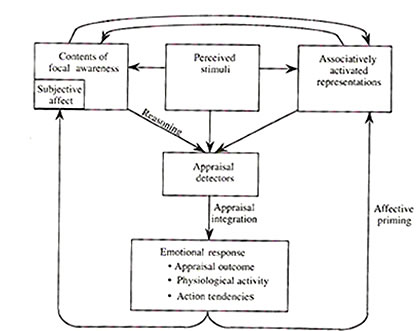
Smith and Kirby (2001) point out some important features of their model:
- From the diagram it can be seen that appraisals come from three sources: the contents of focal awareness, perceived stimuli and associatively activated representations.
- ‘Appraisal detectors’ then integrate this information producing both subjective affect as well as further activating associated representations (affective priming).
- Associative and reasoning processes differ in their ability to access other information. Smith and Kirby (2001) argue that reasoning processes only have access to information that has been encoded semantically whereas associative processes have access to all types of memory.
- The model provides an map for the unconscious/implicit processing of emotion and how it influences other areas of consciousness.
While I’d like to tell you about a whole series of empirical studies that have found support for this model, I can’t because they don’t exist. There are, however, some recent studies that provide some evidence for a functional distinction between implicit and explicit emotional processes. I will discuss these in future posts (research on alexithymia and autisim spectrum disorders).
This model of emotional processing belongs to the ever-growing family of two-process theories in cognitive psychology (e.g. Atkinson and Shiffrin, 1968). These describe an important distinction between two types of process. But, while I doubt they represent the final solution, they do at least provide a useful way of thinking about how the mind processes information. We will, however, have to wait for further evidence of whether this type of model is justified in describing how we process emotional information.
 References
Atkinson, R., & Shiffrin, R. (1968). Human memory: A proposed system and its control processes. The Psychology of Learning and Motivation, 2, 89-195.
Smith, C. A., & Kirby, L. D. (2001) Toward delivering on the promise of appraisal theory. In: K. Scherer, A. Schorr, T. Johnstone (Eds.). Appraisal Processes in Emotion: Theory, Methods, Research. Oxford: Oxford University Press.