Lark vs Owl: 10 Ways Sleep Timing Shapes Your Mind And Body (P)
Night owls and early birds differ in surprising ways, with research revealing links to personality, wellbeing, habits and the brain.
Night owls and early birds differ in surprising ways, with research revealing links to personality, wellbeing, habits and the brain.
Your sleep pattern could influence how vulnerable you are to certain mental health problems.
Larks tend to rise earlier while owls stay up late — each type extends the part of the day at which they feel their best.
Larks tend to rise earlier while owls stay up late — each type extends the part of the day at which they feel their best.
Morning types or ‘larks’ have superior verbal IQ.
Morning types are people who prefer to do demanding things earlier in the day, whereas evening types consider their best time to be later on.
Naturally, larks tend to rise earlier while owls stay up later, with each group extending the part of the day when they feel most alert.
The findings challenge previous studies that suggested evening types have the advantage when it comes to IQ.
Dr Stuart Fogel, study co-author, explained how his study is different:
“Once you account for key factors including bedtime and age, we found the opposite to be true, that morning types tend to have superior verbal ability.
This outcome was surprising to us and signals this is much more complicated that anyone thought before.”
The study included 61 people whose ‘morningness’ or ‘eveningness’ was assessed, along with their cognitive abilities.
The results showed that people who were at their best in the morning scored higher on tests of verbal IQ.
Verbal IQ reflects a person’s ability to use language effectively to reason, communicate and solve problems.
Critically, the researchers had to account for the fact that young people as a group tend to be evening types.
The fact that young people tend to be evening types may make it harder for them to get the best out of the school day, said Dr Fogel:
“A lot of school start times are not determined by our chronotypes but by parents and work-schedules, so school-aged kids pay the price of that because they are evening types forced to work on a morning type schedule.
For example, math and science classes are normally scheduled early in the day because whatever morning tendencies they have will serve them well.
But the AM is not when they are at their best due to their evening type tendencies.
Ultimately, they are disadvantaged because the type of schedule imposed on them is basically fighting against their biological clock every day.”
The study also found that people who kept regular daily routines tended to perform best.
Dr Fogel said:
“Our brain really craves regularity and for us to be optimal in our own rhythms is to stick to that schedule and not be constantly trying to catch up.”
The study was published in the journal Current Research in Behavioral Sciences (Gibbings et al., 2022).
From planning to eating and connecting with others, sleep deprivation affects far more than most people realise.
Your weirdest dreams could be a sign your brain is doing something unexpected.
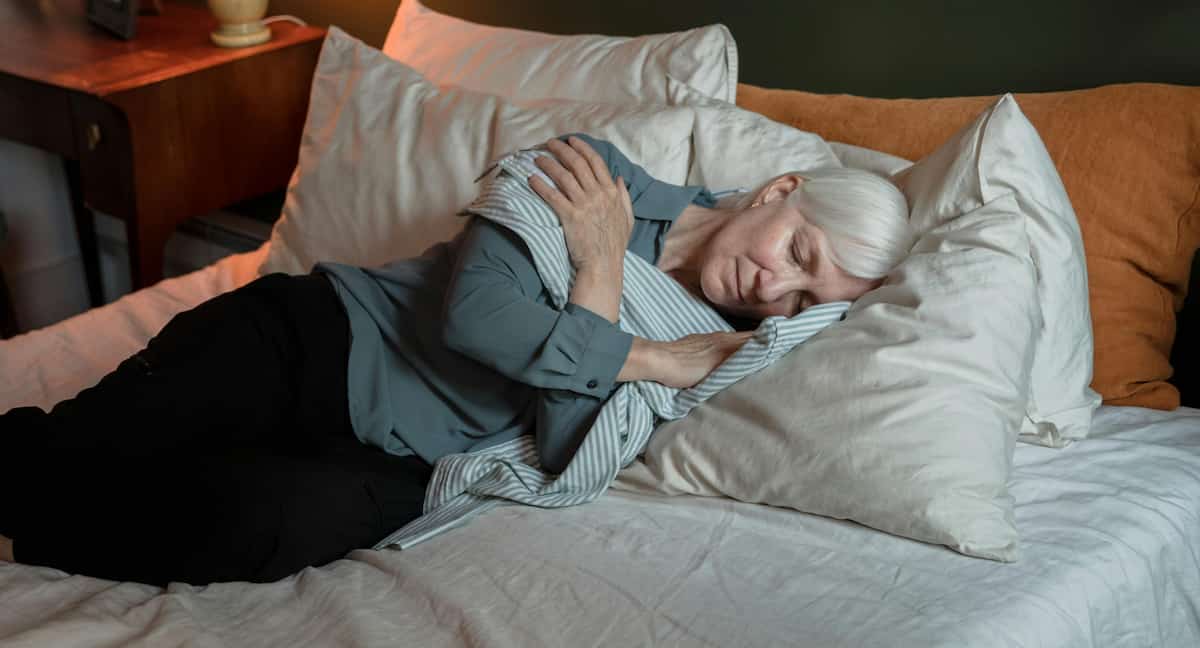
On your side, face-up or face-down? The position which best clears metabolic waste from your brain at night.
On your side, face-up or face-down? The position which best clears metabolic waste from your brain at night.
Sleeping on your side removes waste from the brain most efficiently.
As a result, sleeping on your side may help reduce the risk of Alzheimer’s and other neurological diseases.
Professor Maiken Nedergaard, one of the study’s authors, said:
“It is interesting that the lateral sleep position is already the most popular in human and most animals — even in the wild — and it appears that we have adapted the lateral sleep position to most efficiently clear our brain of the metabolic waste products that built up while we are awake.
The study therefore adds further support to the concept that sleep subserves a distinct biological function of sleep and that is to ‘clean up’ the mess that accumulates while we are awake.
Many types of dementia are linked to sleep disturbances, including difficulties in falling asleep.
It is increasing acknowledged that these sleep disturbances may accelerate memory loss in Alzheimer’s disease.
Our finding brings new insight into this topic by showing it is also important what position you sleep in.”
The study of mice tested the brain’s ‘clean-up’ mechanism in three different sleeping positions:
Scientists monitored how cerebrospinal fluid (CSF) flowed through the brain and exchanged with interstitial fluid.
This pathway — called the glymphatic pathway — clears waste from the brain most efficiently at night.
Professor Helene Benveniste, another of the study’s authors, said:
“The analysis showed us consistently that glymphatic transport was most efficient in the lateral position when compared to the supine or prone positions.
Because of this finding, we propose that the body posture and sleep quality should be considered when standardizing future diagnostic imaging procedures to assess CSF-ISF transport in humans and therefore the assessment of the clearance of damaging brain proteins that may contribute to or cause brain diseases.”
The research was published in the Journal of Neuroscience (Lee et al., 2015).
For some, apps designed to improve sleep actually make it worse.
Even good sleepers frequently experience insomnia.
Even good sleepers frequently experience insomnia.
Around one-quarter of Americans who are ‘good sleepers’ experience acute insomnia each year.
However, without treatment 75 percent recover without developing persistent sleep problems.
Of the rest, 21 percent went on to experience recurring bouts of insomnia and the remaining 4 percent developed chronic insomnia.
Insomnia is defined as having trouble falling asleep or staying asleep for at least three nights a week over two weeks.
The condition becomes chronic when it continues for three months.
Dr Michael Perlis, study author, said:
“Whether caused by stress, illness, medications, or other factors, poor sleep is very common.
These findings reveal new insights about the paths that acute insomnia takes and can inform interventions that target poor sleep and help people recover sustained sufficient sleep.”
The study tracked 1,435 adults for a year.
All were initially defined as ‘good sleepers’: able to fall asleep within 15 minutes and not remaining awake for more than 15 minutes during the night.
The study’s authors conclude:
“The incidence rate of acute insomnia (3 or more nights a week for between 2 and 12 weeks) is remarkably high.
This said, most incident cases resolve within a few days to weeks. Incident chronic insomnia only occurs in about 2 in 100 individuals.”
So, why is insomnia so common?
Insomnia in response to stressful situations may have helped keep our ancestors alive — after all, it is sub-optimal to be fast asleep in your cave when a pack of wolves is outside.
The study’s authors explain:
“…it is possible that AI [acute insomnia] may be normative (i.e. expected as part of the natural rhythm of sleep/insomnia), if not adaptive.
One way this might be true is that the AI that occurs with stress may be an unrecognized part of the fight-flight response; a necessary override to the normal two process regulation of sleep timing, depth and/or duration.
Put differently, stress induced insomnia may prohibit the systematic imperative for sleep under unsafe conditions.”
Unfortunately, knowing that periodic insomnia is normal does not make it any less unpleasant.
The study was published in the journal Sleep (Perlis et al., 2019).
From “aha” moments to a 50 percent lower stroke risk, science proves that napping isn’t lazy — it’s a biological necessity for peak performance.
This nutrient helped children sleep an hour longer.
Join the free PsyBlog mailing list. No spam, ever.