

Mondays Are Not As Depressing As You Think

Mondays should be depressing. The memory of a fun weekend still fresh in the mind, returning to all the problems left behind on Friday and the endless expanse of time until next weekend. Surely Mondays are the most depressing day of the week?
New research, though, suggests Mondays aren't as bad as we think. Unfortunately it also finds that Fridays and Saturdays aren't as good as we imagine either.
Imagined moods
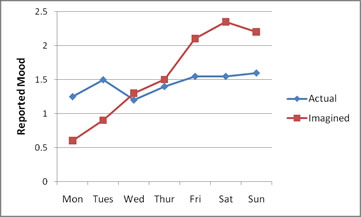
Charles S. Areni of the University of Sydney and Mitchell Burger of the NTF Group surveyed 202 participants about what they imagined was their typical mood on each day of the week. This revealed some predictable results:
- People thought their worst moods were experienced on Monday mornings and evenings.
- People thought their best moods were experienced on Friday and Saturday mornings and evenings.
Fortunately Areni and Burger didn't believe these reports were accurate so they decided to test a further 351 people's moods in the moment by asking them how they were feeling each day, on that day.
Actual moods
They found that, on average, people's mood remained about the same throughout the week. Mondays weren't as depressing as people thought and Fridays and Saturdays weren't as exciting as people predicted.
The results demonstrate the memory bias: when thinking back we tend to recall the worst incidence of an event we've experienced before. Mondays are stereotypically depressing, so we tend to recall the worst Mondays. Fridays and Saturdays are stereotypically exciting so we tend to recall the best Fridays and Saturdays.
Consequently, in reality our mood fluctuation over the week might not follow the stereotypical pattern of a steady increase from a low on Monday through to a high on Saturday. Instead our weekly average mood profile could be much flatter than we imagine.
» This is part of a series on the psychology of the everyday.
[Image credit: crocidillicus]

Join 21938 readers


I have to wonder if the reason we think that way is that we're subconsciously thinking back to a time when that was true: when we were kids going to school.
Fridays meant staying up late, playing with friends without a thought given to homework. School was too far off in our minds to worry about it. Friday night might have even meant a sleep-over.
Saturday mornings meant Saturday morning cartoons. Good cartoons. Not like the ones they have today. Saturdays meant spending almost all day with friends.
By the time Monday rolled around, we were back in school. Suddenly, we had to get up, and go back to the drudgery of it all. And the weekend is so far away it's not even worth thinking about!
We go through that for years; through elementary school, secondary school, and post-secondary school. Then we hit the working world. Lift drifts towards the mean. But the pattern is already ingrained in our psyches.
Just my $0.02.
It may also be pretty much related to range and extend of activities that children and adults can freely engage in during weekend days, which are unrestricted by school and/or work obligations in many cases.
I totally agree that Wednesday sucks more than anything. Mondays aren't as bad as we imagine because most people need and like to work more than they imagine. If we had more free time, we'd be lost and depressed. Often by the time Monday morning rolls around, we're ready to go back to work.
There's nothing good about Wednesday, though. The enthusiasm for the work week has totally worn off by Wednesday. This, coupled with the horrific thought that there's still another TWO DAYS until the weekend comes is almost enough to break a person's soul.
I find Wednesday's most depressing because the week is half done and I'm nowhere near half done my list. I guess I pull ahead or re-evaluate the list by Wednesday. Friday varies, depending on my weekend plans. The thought of finishing a project around the house is always uplifting.
Sunday gets my vote as the most depressing day of the week. As per posts above this is absolutely related to my childhood.
I'm not sure whether the study can be proven to be accurate. However the day doesn't really matter, even though we think it does. You can't really generalize an universal feeling..
Worst days for me, imagined are probably Sunday night and Tuesday. Sunday, because you have to wake up early the next day. Tuesday because you've gotten over the initial excitement of going back to school/work and there's four long days ahead.
I wonder how our moods effect consumer behavior? Maybe when we are feeling happy we spend more frivolously and when we feel sad we are less inclined to spend extra. Any thoughts?
To Shirao question, people actually tend to spend more money when they are in a bad mood. Because buying something gives you a spike, a very, very short one, but still. Think about it, have you ever bought something you could not afford on a day you where in a bad mood, or where stressed? Ever found internet shopping interesting at a time you had to finish a paper, or presentation?