
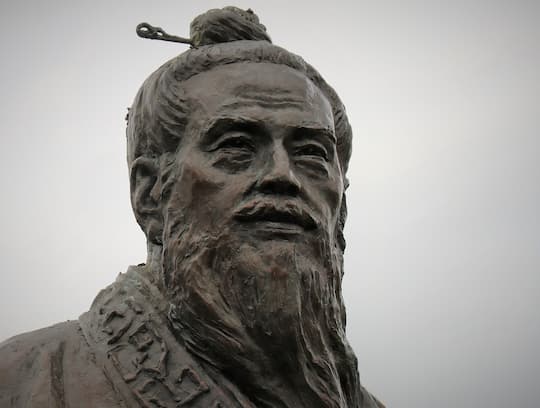
How to Be Happy, Confucian Style

"The one who would be in constant happiness must frequently change." --Confucius
In China two and half thousand years ago one man, Kong Qui, and his followers, synthesised the traditions of the Chinese people to create what they believed were the fundamental principles of humanity. Of course what Westerners now call Confucianism has changed over the years, just like the other major philosophies that have flourished in the East: Buddhism and Taoism. But to have survived this long, these systems of thought must have at their cores a useful set of principles that help people live the 'good life'.
Following on from previous posts on philosophers Epicurus and Schopenhauer, as well as the modern obsession with self-help books, I look at what Ancient Chinese philosophies have to teach us about how to be happy.
In an article in the Journal of Happiness Studies, Zhang and Veenhoven (in press) compare the ancient Chinese versions of Taosim, Buddhism and Confucianism with the modern conditions of happiness. They use findings from the multitude of studies collected in the World Database of Happiness to reach the conclusion that, compared to ancient Buddhism and Taoism, it is Confucius' philosophical teachings that are most likely to lead to a happy life.
So, here (briefly) is Confucius' advice on how to live the good life, contrasted with some of the tenets of Taoism and Buddhism.
1. Invest in intimate ties
Confucianism's view of life is built on the idea of 'Jen'. This means a feeling of concern for the wellbeing of others. Those following Confucianism should bring Jen into both their social relations and, so far as they are able, into society itself.
Compared with the modern observed conditions of happiness this looks like good advice. Generally speaking marriage makes us happier, more friends make us happier and people are especially happy if they have someone to confide in. Classical Taoism goes along with this point but ancient Buddhism runs counter to the evidence, advising the avoidance of intimate ties.
2. Embrace society
Society is accepted within Confucianism and the philosophy encourages its followers to engage in it. Looking at the research, this is also good advice. People who are members of clubs, churches and other organisations are happier, people who have a job are happier, and so on. The evidence shows that this is also true at a societal level. Countries in which people have the densest networks of friends are also those in which people are the happiest.
In comparison, ancient Taoism says retreat to nature and Buddhism says withdraw completely from society - both these points of view are suspect if happiness is your goal.
3. Be successful
Confucianism recommends a devotion to your occupation. The wealth earned from working is also seen in a positive light within Confucianism. Generally speaking people with more money and higher status are happier (but bear in mind that more money doesn't always equal more happiness). In contrast both ancient Taoism and Buddhism are sniffy about earnings.
4. Have fun
Confucius thought moderate amounts of fun were acceptable. This is backed up by modern research finding that people who engage in pleasurable activities are happier (I know, surprise surprise!). Follow-up studies show no long-term disadvantages to a bit of short-term fun. So there's no point rejecting the possibility of happiness, as does ancient Chinese Buddhism, which warns that the pursuit of happiness will only end in disappointment.
5. Live healthily
Still in the land of the blindingly obvious - yes, people who are healthier are happier. Still, just because the advice is obvious doesn't mean it's any less relevant, or any more likely for people to actually act on! Despite this the self-evident nature of this advice, ancient Chinese Buddhism actually recommends physical privation. Again, we'll stick with Confucius on this one.
6. Meet your obligations
One of the most important aspects of ancient Chinese Confucianism is a sense of duty and responsibility. There's some sparse evidence from the individual level that this might lead to greater happiness. At a societal level, however, people who live in collectivist societies, like the Chinese, tend to be less happier than those who live in individualistic societies. This may be because collectivist societies stifle the individual's search for self-actualisation.
7. School yourself
You've guessed it, the well-educated are also happier. On the other hand education mostly contributes to happiness by enabling you to get a better job, and lots of education doesn't necessarily lead to more happiness. One thing is clear though, it is better to live in a more educated society, even if others are more educated than us.
Education is partly endorsed by Taoism, while classical Buddhism advises avoiding school completely. Again, Confucianism wins on this one.
Ancient wisdom
Perhaps it is no surprise that the man who the West knows as 'Confucius' is revered by many as the 'Ancient Teacher' and 'Perfect Sage'. I'm particularly impressed with the prescient quote at the top of the article. This clearly anticipates modern research finding that we quickly get used to new positive experiences so that they no longer continue to increase our happiness.
On the other hand it's important to note that these comparisons are made on the basis of the ancient Chinese versions of Confucianism, Taoism and Buddhism. There is a considerable variation within each of these schools of thought - so much so that for the present purposes the modern versions might as well be completely different schools of philosophy.
Ancient Buddhism does fare badly in this comparison, but people do vary considerably in what they want from philosophical teachings. Not everyone's main aim in life may be to achieve happiness, some may place a higher value on different goals.
» Discover more articles in this series on the new science of happiness.
[Image credit: gwenddydd]
Reference
Zhang, G., & Veenhoven, R. (in press) Ancient Chinese philosophical advice: can it help us find happiness today? Journal of Happiness Studies, 1-19.

Join 22301 readers


I believe the Taoist "return to nature" is more an issue of self-governance than physical relocation.
I believe that you have completely misunderstood Buddhism.
One of the major precepts of Buddhism is compassion for one's fellow beings. There can be no disconnection from society or others in following that precept.
Zen Buddhism, especially, is almost like cognitive behavior therapy in an esthetically pleasing package.
I highly recommend the books of Charlotte Joko Beck, especially her book Everyday Zen, for those who are depressed. It has helped me a great deal.
Chris & Anon., please bear in mind that this article compares the written documents describing the ancient Chinese versions of these philosophies. You may be thinking of different versions.
Anon. especially, Zen Buddhism did not emerge until the 7th Century AD. Also note that this post is based on an article co-authored by a professor in the Department of Philosophy at Zhejiang University.
Hey Jeremy... your entries are usually fantastic, but I think you commit a bit of a howler in the beginning of this post. Specifically, you claim: "But to have survived this long, these systems of thought must have at their cores a useful set of principles that help people live the 'good life'."
Well, umm, no. That argument is a version of Argumentum ad Antiquitam (http://en.wikipedia.org/wiki/Appeal_to_tradition) - just because something is ancient, one can't assume it's necessarily good/beneficial. Plenty of ideas that are really bad for people (religion comes to mind... see "Breaking the Spell" by Daniel Dennett) survive despite being very bad for people. Or, at a minimum, it is certainly contested that only good ideas survive.
Fair point Michael, and the very fact that the ancient principles of Buddhism don't stand up that well when compared to the modern conditions of happiness demonstrates exactly this point.
Thanks for the reply. And good form conceding so quickly - it made me respect you even more. :-)
Jeremy,
In my understanding, it was common to layer multiple meanings into the individual words, phrases, and stories of the Taoist canon; meanings which frustrate a reductive analysis or interpretation. What the authors wrote was usually less than (or in some cases the opposite of) what they actually meant!
This is not to say that attempts at comparison are necessarily futile. But I am skeptical that conclusions such as "Education is partly endorsed by Taoism" can be justified from the source literature (having read many of the translations and commentaries myself).
It's still possible to be happy going buddhism way, ancient one as well. But it probably requires much personal effort, not just 'prefer to do it that way'.
And, it is possible to stop the strive for happiness through philosophy...
Hi Jeremy, just discovered your blog and am really enjoying your articles. I especially like this one about Confucius but looks what's happened! All your commenters are challenging your comments about Buddhism, Taoism and the logic of allocating value to ancient wisdom because it's ancient.
So far, nobody has commented on your really helpful short explorations of Confucius in the light of modern studies of happiness. That's a shame because this is SUCH an interesting collection of points.
"The one who would be in happiness must frequently change" is so good in itself. Change is an inescapable fact of life. As a doctor, I often find patient's are in the deepest suffering because of their inability to accept this and to embrace change as a way of dealing with change. Trying to deny or resist change seems to me to be a key factor in unhappiness.
Your first two points about relationships and society are arguments for engagement. I'm pretty sure this is an equally important fact of life. We are all embedded beings, all living our lives inextricably woven into the environments and contexts of our existence. Fully embracing an engaged way of living is likely to be both more successful and also more happy.
Devotion to occupation sounds a bit like Czisentmihayi's "flow" work - the idea that when you're completely absorbed in achieving a task, goal or activity you're happy.
Yeah, having fun, being healthy and learning might seem obvious but good to put them in here.
It looks like the one principle you're not so sure about it the obligations. Is this the same as duty and responsibilities? If so, isn't the collectivist argument a red herring? Aren't the principles of responsibility, duty and obligation just as relevant in all societies? Maybe it's because if nobody in society rates these values all individuals suffer?
Anyway, thanks for this great post, and I'm sorry to see it got side-tracked, but I think you'd have headed that one off the pass if you'd passed on the Taoist and Buddhist comparisons.
Issues of engagement and adaptability are at the heart of my blog - heroesnotzombies.wordpress.com - you'd be most welcome to come and have a read.
Bob
All, thanks for your comments. I'm happy to see these ideas being challenged - it shows people are interested and engaged. Happy to hear from you all!
Sir,
first of all, compliments on this blog - I've been reading it for about an hour or so and thorouhly enjoyed it!
second: I am rather surprised that there is an interpretation of Buddhism which doesn't emphasize schooling as a good thing. From my own personal knowledge, what Budha rebelled against was the mechanical, rote memorization practised by Hindu Brahmins. But he did admonish his students to "think for themselves" and "train their minds". Might it be that Chinese BUddhism is not an accurate representative of Buddhism at all?
I am curious as to what Confucian himself would say to your entry on "success." Stating that "the wealth earned from working is also seen in a positive light" is rather assuming, as I am sure there are just as many happy poor people, as there are sad rich people in 2008. Implying that Confucious believed in a correlation between monatary earnings and true happiness seems wrong, and surely such an enlightened individual would think otherwise.
I think there are other more biological components that also contribute to happiness. In terms of living healthy, when one performs vigorous exercise, endorphins (substance similar to morphine) are released which stimulate the feeling of happiness. Ergo, physical activity should be emphasized if one's goal is to be happy.
Zen recommends withdrawal from society so that practitioners can fully focus on mindful awareness. This is very different then just not having friends. Zen is a special case in which practitioners develop a relationship with themselves using the same mirror neurons that handle social relations with others (Siegel, 2007)
The Dalai Llama once said it's not about being happy. It's about find meaning. Happiness is only a byproduct.