
Superstitious Pigeon-Guided Missiles

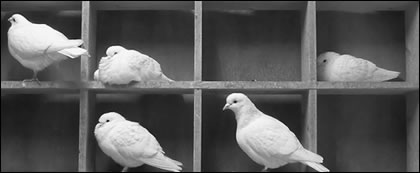
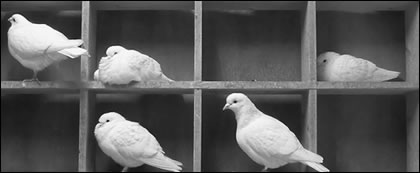
Pigeons

[Photo by libraryman]

During WWII, in the days before cheap computing, guiding a bomb to its target was a more miss than hit affair. While the military were working on their first crude electronic guidance systems, one famous psychologist, B.F. Skinner, had an unusual idea.

Skinner, who had been developing ways of training animals, thought that an expendable animal with excellent eyesight and high manoeuvrability could be trained to guide anti-aircraft missiles to their targets. And so we continue this series on weird psychology with the imaginatively titled: 'Project Pigeon' (Skinner, 1960).

Pigeon-guided missiles
First what was needed was proof of concept so Skinner set up a pigeon training area which consisted of a pigeon in a man's sock looking at a picture of a 'target'. The pigeon could then peck on one of four levers that moved the 'target' up, down, left and right.

This prototype seemed to work with the pigeons keeping the target in the centre. Skinner thought this was proof that a pigeon-guided missile was a real possibility. In fact, he planned on having three pigeons in the nose cone of each missile, thinking this would provide a more failsafe system.

The military got as far as adapting some missiles to accommodate the pigeons before eventually deciding electronics was a better bet for the future and killed Project Pigeon. They were also understandably nervous about a load of heavily-armed pigeons flying around the skies.

Superstitious pigeons
While the pigeon-guided missile died, the idea of using a box with levers for experimenting with animals lived on in the form of a 'Skinner box'. It was using this that Skinner then made the surprising claim that pigeons could be superstitious (Skinner, 1948).

A hungry pigeon was placed in a Skinner box and fed once every 15 seconds. But soon it began to exhibit unusual behaviours. In one case it began stretching its neck just before the food was delivered. In another the pigeon started walking in circles. Yet another stuck its head in the corner.

Skinner argued the pigeon had come to associate the movement of its neck, or walking in circles around the box, or sticking its head in the corner with the reward of food. So it now believed it had to move its head to get fed. It had become a superstitious pigeon.

Skinner would give lectures in which an apparently passive pigeon was placed into the Skinner box at the start. After an hour or so the box's cover would be removed to reveal a pigeon now engaged in some bizarre behaviour.

Personally I think the pigeons got wise. After all, would you rather dance for your supper or be strapped to a missile?

» Read more weird psychology studies.

References - Click here to toggle visibility

  • Share/Bookmark

9 comments

  1. Ed Yong says:

    The pigeon-guided missiles are hilarious (although as I understand it, our current 'guided' technology isn't really all that accurate either)
    I wonder, if Project Pigeon had got off the ground, would we have seen an arms race, where the pigeon-guided missiles would be shot down by falcon-guided missiles? :-)

  2. dadog126 says:

    is this how religion began?

  3. Jeremy (PsyBlog author) says:

    Ed - good one!

    Dadog - Skinner certainly thought the apparently superstitious behvaviour of pigeons formed the basis of superstition in humans. You'll need a few more factors than just superstition to explain religion though!

  4. Jeremy (PsyBlog author) says:

    Searching Google, you can see pictures of the prototype warhead.

  5. Al Bedard says:

    In the narrow sense, superstition is the belief in a cause and effect that doesn't exist, and yet is self full-filling. In the case of the pigeons, any random action it did just before the automatic feeding may seem like a cause to it. If it tries the "cause" action again, just before the regular feeding, it responds as if they two are linked. It quickly become self-conditioned to perform this action to "cause" the food to appear. In reality, the behavior of the pigeon does not affect the feeding, but the pigeon now behaves as if it is. This truly is a superstition. The feeding does exist. The pigeon's superstition doesn't cause it.

    Likewise, superstition in religion does not mean that God doesn't exist, but that believers have come to associate some non-causal belief with their belief in God, and they will then defend the non-causal belief (the superstition) as strongly as they defend their belief in God, incorrectly associating the belief of the former with the belief in the later.

  6. Jeremy (PsyBlog author) says:

    Al, useful clarification - thanks.

  7. Bruce Abbott says:

    Jeremy -- A couple of minor corrections: The "pelican" was to be a smart bomb, not a guided missile, and it was to be used against Japanese naval ships, not aircraft. The Japanese had their own smart bombs, which they actually used against American naval ships in the Pacific during WW II. They were flown not by pigeons but by human Kamakazee pilots.

  8. Jeremy (PsyBlog author) says:

    Thanks for the correction Bruce.

  9. roffe says:

    The Supersition in the pigeon article (http://psychclassics.yorku.ca/Skinner/Pigeon/) may not be the most relevant background article for the present study, as there is nothing superstitious about the training of the guiding pigeons. The pigeons in Skinner's study were trained by operant conditioning.

    The article Skinner published about the project is quite an example of how a scientific paper should be written: comprehensive, it outlines the history and background of the project, mentions ethical implications, and is full of Skinner's dry humor.

    It's occasionally available on the Web. It can be found in Cumulative Record, which is a collection of Skinner's most noticeable papers.

    The project was evnentually closed down and replaced with a competing and more commercially successful project: Radar.

» Comments are now closed on this post «

Archives