

 Did you know they’ve taken the word ‘gullible’ out of the dictionary? This one went around endlessly at school and I almost fell for it the first time, but never again. Why would I?
And so I segue mysteriously (yet relevantly) into the Channel 4 ‘Bodyshocks‘ series of documentaries. This week’s programme focussed on ‘the girl with the x-ray eyes’. Natasha, a seventeen-year-old from Russia claims to literally see inside people in order to diagnose their medical conditions. Having submitted to the sceptic’s tests, she was debunked, but not entirely satisfactorily.
And now my final, and not so mysterious segue, is into Professor Richard Wiseman’s research into spoon-bending. He had two sets of undergrads witness the trick. In half, the wannabe Yuri suggested that the spoon continued to bend after he put it down. Sure enough 40% reported the spoon continuing to bend – as if by magic.
→ Read on about why the debunking might not have been satisfactory.

 It’s much easier to make a credible looking website than it is to make a credible looking book. So when you’re on the web, how do you evaluate the credibility of the information you’ve found? On average, it seems, not very well!
 “A specially prepared extract of the herb St John’s wort is at least as effective in treating depression as the powerful antidepressant drug Seroxat and has fewer side-effects, a study has indicated.”
 The Guardian asks leading scientist to gaze into their crystal balls and ruminate on the next scientific revolution. V S Ramachandran, the neuroscientist, comes up with my favourite quote:
 The green box contains a brand new rat neuron. Why is this important? Well, until quite recently researchers were unsure of two things: whether it’s possible for the brain to change and whether it can grow new cells. With the help of rats and monks, the answer is emerging: quite possibly yes.
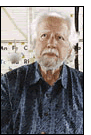 Ecstasy’s emergence as a popular recreational drug can be traced back to one man. Although the drug was first synthesised by Merck in 1914, it was initially thought to be useless, and immediately forgotten. It wasn’t until 1976 that an eccentric chemist, Alexander Shulgin (above), resynthesised it on the suggestion of a former student.
 With changes proposed to the licensing laws in the UK there’s been lots of talk about binge drinking. The suggestion is that opening the pubs and bars at all hours will encourage binge drinking.