

A simple grocery habit that has a similar impact on happiness to landing a dream job.
Eating eight portions of fruit and veg a day provides the ultimate boost to your everyday happiness.
The positive emotional effect comes more quickly than the boost to health.
Up to eight portions, the more portions people eat, the happier they are.
The effect on happiness of eating those eight portions compared with none is dramatic.
In terms of life satisfaction, it is equivalent to the difference between being employed and unemployed.
Beyond health benefits
The graph below shows the increase in life satisfaction with portions of fruit and vegetables consumed each day.
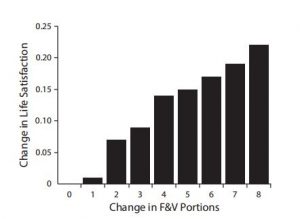
Graph courtesy of Mujcic & Oswald (2016)
It is the first time a large study has found that fruit and vegetables contribute to happiness on top of their well-known protective effects against cancer and heart disease.
Professor Andrew Oswald, one of the study’s authors, said:
“Eating fruit and vegetables apparently boosts our happiness far more quickly than it improves human health.
People’s motivation to eat healthy food is weakened by the fact that physical-health benefits, such as protecting against cancer, accrue decades later.
However, well-being improvements from increased consumption of fruit and vegetables are closer to immediate.”
The chemistry of optimism
The conclusions come from following over 12,000 people.
Participants kept food diaries and their psychological wellbeing was measured.
The results revealed a striking trend: within just two years, participants who loaded up on greens reported a massive shift in how they felt.
Dr Redzo Mujcic, one of the study’s authors, said:
“Perhaps our results will be more effective than traditional messages in convincing people to have a healthy diet.
There is a psychological payoff now from fruit and vegetables — not just a lower health risk decades later.”
One possible mechanism by which fruit and vegetables affect happiness is through antioxidants.
There is a suggested connection between antioxidants and optimism.
Related
The study was published in the American Journal of Public Health (Mujcic & Oswald, 2016).