

Forming a habit takes an average of 66 days, but it depends on the habit and how you build it.
Say you want to build a new habit, whether it’s taking more exercise, eating more healthily or writing a blog post every day, how long does it need to be performed before it no longer requires Herculean self-control?
Clearly it’s going to depend on the type of habit you’re trying to build and how single-minded you are in pursuing your goal.
But are there any general guidelines for how long it takes to form a habit before behaviours become automatic?
Ask Google a few years ago and you used to get a figure of somewhere between 21 and 28 days.
In fact, there’s no solid evidence for this number at all.
The 21-day myth for how long to form a habit may well come from a book published in 1960 by a plastic surgeon.
Dr Maxwell Maltz noticed that amputees took, on average, 21 days to adjust to the loss of a limb and he argued that people take 21 days to adjust to any major life changes.
Unless you’re in the habit of sawing off your own arm, this is not particularly relevant.
Forming a habit takes 66 days
Psychological research on this question is available, though, in a paper published in the European Journal of Social Psychology.
Phillippa Lally and colleagues from University College London recruited 96 people who were interested in forming a new habit such as eating a piece of fruit with lunch or doing a 15-minute run each day Lally et al. (2009).
Participants were then asked daily how automatic their chosen habits felt.
These questions included things like whether the potential habit was ‘hard not to do’ and could be done ‘without thinking’.
When the researchers examined the different habits, many of the participants showed a curved relationship between practice and automaticity of the form depicted below (solid line).
On average, a plateau in automaticity was reached after 66 days.
In other words, it had become as much of a habit as it was ever going to become.
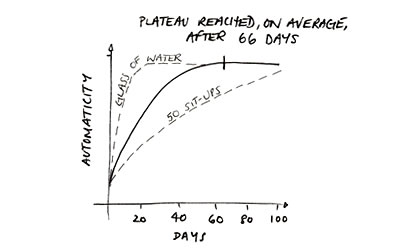
This graph shows that early practice was rewarded with greater increases in automaticity and gains tailed off as participants reached their maximum automaticity for that behaviour.
Although the average was 66 days, there was marked variation in how long habits took to form, anywhere from 18 days up to 254 days in the habits examined in this study.
As you’d imagine, drinking a daily glass of water became automatic very quickly but doing 50 sit-ups before breakfast required more dedication (above, dotted lines).
The researchers also noted that:
- Missing a single day did not reduce the chance of forming a habit.
- A sub-group took much longer than the others to form their habits, perhaps suggesting some people are ‘habit-resistant’.
- Making other types of habits may well take much longer.
Making a habit: there is no small change
What this study reveals is that when we want to form a relatively simple habit like eating a piece of fruit each day or taking a 10 minute walk, it could take us over two months of daily repetitions before the behaviour becomes a habit.
And, while this research suggests that skipping single days isn’t detrimental in the long-term, it’s those early repetitions that give us the greatest boost in automaticity.
Unfortunately it seems there’s no such thing as small change: the much-repeated 21 days to form a habit is a considerable underestimation unless your only goal in life is drinking glasses of water.
Related
- Simple repetition is the key to hacking your brain to form solid habits.
- 8 ways to stop biting your nails.