
Can You Change Your Personality? Lord of the Rings vs. Schindler’s List

Self-help gurus talk as though personality change can occur as predictably as the story arc of a Hollywood hero. Psychologists fall into this trap as well. Research on student's views about intelligence implies that if we want to change ourselves, all we have to do is change our beliefs about what is possible. Similarly our culture through the media, the self-help industry and some psychologists promotes the idea that change is an easy, everyday process, if only we could really want it. In fact our culture has become obsessed with technologies of the self, our ability to easily reinvent ourselves, to become, as it where, new people.
This breezy talk about personality change is far-fetched because for most of us change only comes after prolonged effort. But to illustrate how our culture represents personality change, take two examples of movie heroes, one who was miraculously steadfast and one who was miraculously transformed. As you're reading, think firstly about which best represents the way our culture views personality and secondly about which best represents your view of your own personality.
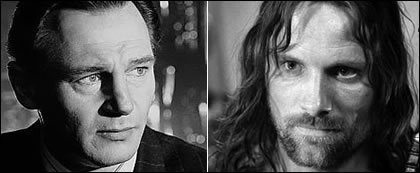
Oskar Schindler
The modern obsession with the possibility of redeeming psychological transformation can be clearly seen in Schindler's List. Oskar Schindler - the hero as he becomes - starts out as a greedy man obsessed with profit and his own personal gain, making money using cheap Jewish labour to supply the Nazi regime. By the end of the film Schindler has undergone a miraculous transformation into a man risking his life and livelihood to smuggle Jews to freedom.
This film, which is difficult to watch, inspirational and incredibly moving all at the same time, is also totally unbelievable. And my incredulity is in no way tempered by the fact this film is based on a true story. They say fact is stranger than fiction, and they are right.
What this film does represent is a kind of movie archetype of heroic transformation. An unlikely protagonist comes face to face with a situation which demands some kind of change. He then becomes a hero by virtue of the change he undergoes.
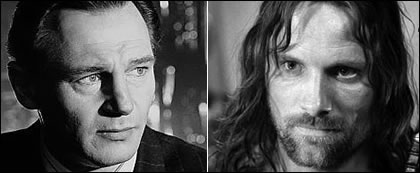
Aragorn
The opposite message about human nature comes from a fantasy movie. Watch Lord of the Rings and find characters whose personalities are set in stone. Aragorn, greatest in its array of heroes, is a man who tries to avoid his appointed task but cannot. Boromir, meanwhile, is also a hero, but one with a fatal character flaw, one which he cannot avoid no matter how hard he tries.
Those who are flawed, like Boromir, are flawed right from the start, while those who are heroes, like Aragorn, battle on through to the bitter end. In Lord of the Rings it is personalities that remain largely unchanged, only the situations they encounter change. Aragorn cannot avoid his destiny, however much he tries. He was born to be King and he shall be King. Boromir, however, is doomed to betray his friends right from the start.
Back to reality
Part of the problem with using extreme situations such as those from movies is that they are difficult to translate into real life. Most of us have not faced, and probably never will face, the moral dilemma of Oskar Schindler. Neither will any of us save Middle Earth from hordes of orcs. In reality life is much more mundane. But just because most of us will never face the extreme situations portrayed in these movies, it doesn't mean watching them won't affect the way we think about ourselves.
Watch enough Hollywood films and you'll start to believe life is all about reaching crises, a brief period of confusion followed by triumphant discovery of new patterns of behaviour. Are human beings really capable of these kinds of transformation in short periods of time? A failure to change is frequently seen as depressing or limiting. To be considered 'life affirming' and uplifting movies and TV shows need to show people continually reinventing themselves. We worship the 'new', and that includes our new personalities as well.
Personality stability
Psychological research tells us that people's personalities are actually relatively stable over their lifetimes. What changes as we age is probably not the larger, more obvious aspects of our personality, but the little things we do. The types of things that would normally sneak under the radar of psychology studies. Our experience broadens, or narrows, our lives are struck by dizzying triumph and cavernous misfortune, and we march on, most of us, making tiny changes as we go.
As any management consultant will tell you, people are remarkably resilient to change and ultimately this inflexibility is necessary for our survival. As an evolutionary psychologist would say, it's adaptive behaviour. If we were too easily influenced to change our beliefs, our attitudes, our whole direction in life, we would never achieve anything. What our culture worship as its greatest achievements in the arts, sciences and politics, were mostly achieved by people who were remarkably stubborn in sticking to their vision.
So while Schindler's List best represents the culturally promoted view of personality as capable of transformation, Lord of the Rings better represents reality. Which is ironic considering it is a fantasy movie.
Perhaps the only way we can deal with the truth about ourselves is to hide it amongst elves, dwarves and hobbits.


Join 22301 readers


> "Neither will any of us save Middle Earth from hordes of orcs."
Give me time.
Our personalities are built up out of our life experiences. I am not the same person that I was 20 years ago and I don't expect to be the same person 20 years from now. Can anyone truly say that they haven't had any significant personality changes over time? To live is to change.
This is a question of never-ending fascination. While I incline to the belief that no one's personality fundamentally changes (by which I mean going to a polar opposite), I also tend to agree with Mr. Vitelli about the role of experience & growth. Surely Oskar Schindler must have possessed some fundamental human decency that he no doubt repressed for the sake of business success; when confronted with the extreme evil of Nazism he apparently recovered it. My theory anyway.
Romeo, you're right, it's rare that we stay exactly the same - but it's also rare that we change out of all recognition. It's a matter of degree isn't it? I would say it's much more common for us to only change somewhat than to undergo huge transformations.
Greg, in a way you're arguing Schindler didn't change during the film but repressed his real self. That's an interesting intepretation of the film. The point I would make is that Schindler also could have taken an intermediate path. He could have taken his money and left Germany to set up business elsewhere. To go from exploiting Jews to saving their lives was a complete about face.
Clearly "some fundamental human decency" does not exist. The dearth of historical and experiential evidence attests to this.
As for personality transformations, I personally have undergone several and witnessed others do the same. I also disagree completely that [American] culture views the self structure as highly changable. "Be yourself," veritably the mantra driven into every child through tv, media and role models everywhere presumes the existence of an inherent self. AA shows a reasonable success rate for a system of major personality change based on psychological technology that remains at least 150 years behind the times. The structure of the nuclear family, the Western legal structure, the commercial and economic systems all work together to produce highly predicatable individuals who remain unlikely to change their behaviors significantly after the age of 25. Look at what population management consultants have to use as their sample base. Nietzsche's Geneology of Morals, Foucault's Disicpline and Punish and Freud's Civilization and Its Discontents all describe various aspects of the social environment acting to limit variation in the individual; Freud and Nietzsche have more interest in how the individual internalizes the expectations of society while Foucault looks more at how society expedites the process.
Anecdotally I understand that family therapists see preliminary improvements in an individual member dissolve as the stress within the family grows in response. The system attempts to restore homeostasis as the individual's troubles appear only as the visible symptoms of the family's collective illness.
"If anyone comes to me and does not hate his father and mother, his wife and children, his brothers and sisters—yes, even his own life—he cannot be my disciple."(Luke 14:26)
I've been impressed by Schindler's List for a different reason. Its portrait of Schindler reveals a frequently ignored truth: the personality of many heroes includes a healthy dose of risk-taking, self-importance, narcissism, feeling above-the-rules, thrill-seeking, etc. Schindler's pre-WW II lifestyle of womanizing, conniving and amassing wealth *and* his wartime heroics are consistent with these traits. When history demands great risk, I think an argument can be made that there are more important traits than a good moral compass and ethical vision.
Cole, thanks for the interesting comment. One minor clarification: in this post I'm trying to separate what culture, through film, tells us is possible about change from the reality of how much change we actually undergo. It would be interesting - but sadly next to impossible - to know how much of this process of internalisation actually occurs. I would argue these socialisation processes do not rule us to the extent that Foucault and others (social constructionists) think.
Jack, I like the alternative analysis, although I can't agree with your last point!
Personality is like a river. Constant, yet, fleeting.
Yes I beleave so, I'm a victim of such. Do we forgot our history and those days where mithology ruled. What can we say about false profects? at least.
In my childwood, and after, now-a-days, I'm socially what other made apon my words, and not what I trully beleave! Even my emotions and thoughts are not the same. I'm a really excluded one, with no good feelings or chance to prove myself unless if accepting their willing, or became that self strange person with those self alergic feelings and thoughts.
A hiper-active person, with no contacts with the inner or him self, just accepting what ever is sent and living according to that.
That's the result of no really friends that really understand all created mistified reality around us!
What a load of tosh. That is probably the least researched piece masquerading as fact I have read.
I completely agree with Romeo above, our self changes to meet the environment. Also, if we can't or don't fundementally change then what do you think psychotherapy is about? Maybe the important questions are 'what is personality?' and 'what is fundemental change?'.
Petit, thanks for your comment, very interesting.
Wilberforce, it's pretty clear this post is just my opinion. Also, I'm not saying people can't change, but that it's more difficult than movies and other media often imply.
nice site you have, thanks for sharing, have a look at http://badmovieknights.com/ when you get time :>
I think personality changes with experience. We go though alot of tough things in ours lives (or so they seem at the time) but I think we learn from the bad situations and change accordingly.
For example I always used to choose the wrong type of men and they would always hurt me (but after getting hurt a few times i realised what my mistakes were, now i have totally differet tastes in men.