

The search for a particular book takes longer when the library is larger and more complex.
People’s memories get more cluttered with age, which is why many healthy older people have certain difficulties with retrieval.
Naturally, the search for a particular book takes longer when the library is larger and more complex.
Yet, a ‘cluttered’ memory carries distinct advantages.
Indeed, whether you call it a ‘cluttered’ memory or an ‘enriched’ memory depends on the result you expect.
For a specific answer to a precise question — such as identifying the capital of Paraguay* — clutter is the enemy.
Creativity, for instance, thrives on making unexpected connections between disparate ideas.
An older mind naturally recalls a more diverse array of memories — a trait that can be highly advantageous for creative thinking.
When older people recall information to make decisions, they are more likely to remember a wider variety of circumstances.
This wealth of experience may aid decision-making.
Even learning can be easier when you have more hooks on which to hang newfound knowledge.
Memory paradox
These ideas about memory and aging come from an article published in the journal Trends in Cognitive Sciences.
The authors were inspired by a paradox at the heart of memory: why do older people struggle to remember specific personal events despite possessing greater knowledge and wisdom?
Their answer is that healthy older people (60+) encode ‘too much’ information.
Consequently, when they attempt to retrieve a memory, a flood of irrelevant and unrelated information surfaces alongside it.
Here is how they represent it visually:
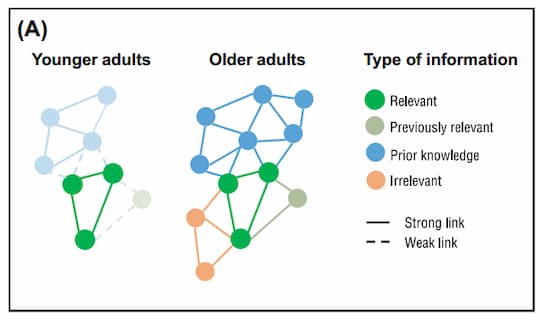
It is harder for older people to suppress irrelevant information, whereas the younger mind is more likely to zoom in on what is relevant.
Harder to suppress memories with age
A wide range of research in the neuroscience of memory supports these conclusions, the study’s authors argue.
Studies consistently show that older individuals face distinct challenges when trying to suppress irrelevant data.
As a result, searching for a specific memory often triggers an influx of unrelated background information.
The study’s authors summarise this dual-edged nature of cognitive aging in the paper:
“Older adults have greater knowledge of the world but generally show poorer episodic memory performance on many laboratory-based tasks relative to young adults.
Here, we propose that this paradox can be accounted for, at least partially, by the uniquely cluttered/enriched memory
representations of older adults.Specifically, unlike young adults, older adults’ memory representations contain target information bound to irrelevant
and/or knowledge-based details, likely formed as a function of reduced cognitive control.With these cluttered or rich representations, older adults are more likely to activate excessive information.
This, in turn, can pose retrieval difficulties for target information (and negatively impact episodic and working memory tasks), but can also aid performance on tasks, such as creativity, decision-making, and sometimes new learning, which benefit from access to knowledge from various sources.”
Related
- Part of the function of forgetting some things is to help us remember what is important.
* For those who are suffering, the capital of Paraguay is Asunción — not, as I once heard, Uruguay.
The study was published in the journal Trends in Cognitive Sciences (Amer et al., 2022).