
I’m sitting in front of the computer and I’ve been working too hard for too long without a break. My brain feels like it’s filling with wet cardboard. In fact what I’m doing isn’t writing any more, it’s just typing. I go to the kitchen, stand there for a moment, can’t remember what I’ve come in for, feel foolish, then eat a biscuit.
It doesn’t help.
Time for a walk. But where to? Perhaps into town to pick up some supplies, or maybe the other way, towards the park and the river?
Most of us are aware that a quick walk around the block does wonders for the mind. But what a new study reveals is that if you want to come back with your brain power enhanced, the scenery en route really matters.
Communing with nature
Marc G. Berman and colleagues at the University of Michigan wanted to test the effect of a walk’s scenery on cognitive function (Berman, Jonides & Kaplan, 2008). In the first of two studies participants were given a 35 minute task involving repeating loads of random numbers back to the experimenter, but in reverse order. After this cognitive psychology special (!) they were sent out for a walk – one group around an arboretum and the other down a busy city street – both while being tracked with GPS devices. They each repeated the memory test when they got back.
The results showed that people’s performance on the test improved by almost 20% after wandering amongst the trees. By comparison those subjected to a busy street did not reliably improve on the test.
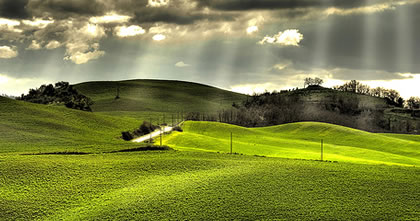
In the second study participants weren’t even allowed to leave the lab but instead some stared at pictures of natural scenes while others looked at urban environments. The improvements weren’t quite as impressive as the first study, but, once again, the trees and fields beat the roads and lampposts.
These results replicated a previous study by Berto (2005) who found that just viewing pictures of natural scenes had a restorative effect on cognitive function. People’s performance was soon restored by picture of trees, fields and hills, but not by streets, industrial units or even complex geometric patterns.
Attention Restoration Theory
What is it, then, about being immersed in real natural scenes that allows the mind to unwind? Kaplan (1995) provides a nice explanation based on the idea that attention is split into two types:
- Involuntary attention is grabbed by whatever is most immediate to our survival. We have less control over this and consequently find it very difficult to ignore things like buses coming straight at us.
- Directed attention is what we use to override our instinctual, involuntary attention. It allows us to resolve conflicts so that, for example, we can work out we are in more immediate danger from a car overtaking that bus. Vitally, directed attention is thought important to our short-term memory.
Imagine crossing a busy street: our involuntary attention is being pulled one way then the other by all sorts of stimuli. There are other people on a collision course, crossing signals to decipher, police sirens in the distance – not to mention the cars, buses and motorcycles whizzing past on the road. All this buzz means we continually have to decide where our attention should be directed. This is tiring.
In comparison natural scenes only engage our involuntary attention modestly: it’s enough to stop us getting bored, but not so much we need to engage our directed attention to work out where to put our focus. Effectively gazing at the sunset gives our directed attention a rest and we can let our minds wander.
Trees and fields: the ultimate cognitive enhancers?
So just as we might have predicted nature is a kind of natural cognitive enhancer, helping our brain let off steam so it can cruise back up to full functioning. The beauty of this study is it neatly tests the idea and puts a concrete number on the improvement. Of course it only tested an arboretum, and only one type of cognitive function. It may well be that other natural areas provide even greater benefits. What about the sea-side, sunsets or sand dunes? What about perception, problem-solving or executive function?
Whatever the outcomes in different natural environments, these benefits for cognition are impressive for what is essentially a free activity (providing natural areas are close). In fact these results are even more impressive when you consider the difficulty researchers have had showing the benefits of ‘brain training’ software for cognitive function (see: which cognitive enhancers really work?).
Like many a favourite psychology study this one is also practical. When our minds need refreshing and if natural scenery is accessible, we should take the opportunity. If not then just looking at pictures of nature is a reasonable second best.
Of course many people already decorate their homes with images of landscape, probably without realising the cognitive benefits. So even if you can’t get out of the house, and all your windows look out onto urban jungle, when you need a break take a glance at a few images of nature. Flickr wouldn’t be a bad place to start.
» Related: Activities in the open air have the strongest restorative effect on our mental states.
→ Continue reading: Memory and Recall: 10 Amazing Facts You Should Know
[Image credit: l’etrusco]