
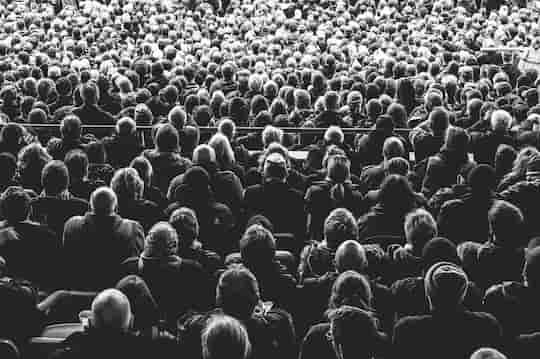
Crowd psychology research finds that masses and mobs are not the many-armed destructive monsters of the popular or even fascist imagination.
How do you imagine an archetypal crowd of people – say at a concert, a sporting event or a demonstration?
If you picture an irrational, spontaneous, suggestible, emotional and even potentially dangerous group then you are in good company.
Sociologists David Schweingruber and Ronald Wohlstein have found this view of crowd psychology is promoted by many authors of introductory sociology and psychology textbooks.
Indeed the idea that crowds demonstrate bizarre, almost pathological behaviour was championed by eminent French sociologist Gustave LeBon.
Despite these beliefs both in sociology textbooks and in the general public, the actual evidence of crowd psychology does not support it.
Crowds are not the many-armed destructive monsters of the popular or even fascist imagination.
Here are seven myths about crowd psychology that Schweingruber and Wohlstein identify, in order of how frequently they appear in introductory sociology textbooks.
1. Crowds are not spontaneous
The most common myth about crowd psychology is that they are spontaneous, or worse, that they are hotbeds of violence, with complete chaos only a few ill-judged jostles away.
Research into crowd violence does not support this.
One study of riots shows that violence is normally related to the presence of two opposing factions.
Mixed crowds – which are the norm – are in fact usually peaceful and only engage in stereotypical crowd-behaviour, e.g. whistling and clapping, face-painting, singing and shouting depending on the occasion.
In reality, most people will go to almost any length to avoid actual violence, whether they are in a crowd or not.
2. The masses are not suggestible
The idea that people in crowds have heightened suggestibility is also a relatively common myth.
People are said to copy each other, looking for a leader, being open to others’ suggestion about how they should behave, perhaps resulting from a lack of social structure.
Schweingruber and Wohlstein simply find no research to back up this claim.
If there is some truth to the idea that people in crowds are suggestible, no one has managed to demonstrate it empirically.
One scholar has asked why, if crowds are so suggestible, they don’t disperse when asked to do so by an authority figure.
3. Crowd psychology is not irrational
One type of irrationality frequently attributed to crowd psychology is panic.
Faced by emergency situations people are thought to suddenly behave like selfish animals, trampling others in the scramble to escape.
A long line of research in crowd psychology into the way people behave in real emergency situations does not support this idea.
Two examples are studies on underground station evacuations and the rapid, orderly way in which people evacuated the World Trade Center after the 9/11 terrorist attacks.
Many lives were saved that day because people resisted the urge to panic.
Resisting the urge to irrationality, or panic, is the norm.
4. Crowds do not increase anonymity
A less common myth, but still popular is the idea that people become more anonymous when they are in a crowd.
This anonymity is said to feed into spontaneity and even destructiveness, helping to make crowds violent, dangerous places in which society’s laws are transgressed.
Everyday experience, though, is that people usually travel in groups, with their family or friends, and so are not anonymous at all.
Crowd psychology research confirms this, for example one study from the 70s found that most people at a football match were with one or more friends.
Later research has repeated this finding.
5. Crowds are not emotional
Less widespread this myth – nevertheless crowds are thought by some to be particularly emotional.
It is argued that increased emotionality is linked to irrationality and perhaps violence.
Modern psychological research, though, doesn’t see the emotions as separate to decision-making, but rather as an integral part.
To talk about an ’emotional crowd’ as opposed to a ‘rational crowd’, therefore, doesn’t make sense.
People in crowds make their decisions with input from their emotions, just as they do when they’re not in a crowd.
6. Mass psychology is not unanimous
Few of the sociology textbooks endorse the myth of unanimity, but the idea does appear that when people are together they tend to act in unison.
Research suggests, though, that this is rarely the case – people remain stubbornly individual.
7. Crowd psychology is not destructive
The least common myth in the sociology textbooks, but quite a strong cultural stereotype of crowds, is that they are destructive.
This is closely related to the myth of spontaneity and is often connected to violence.
Again Schweingruber and Wohlstein find that the research (like this) shows violence in crowds is extremely rare.
And what violence does occur is normally carried out by a small minority – these are the people that make it onto the news.
.