
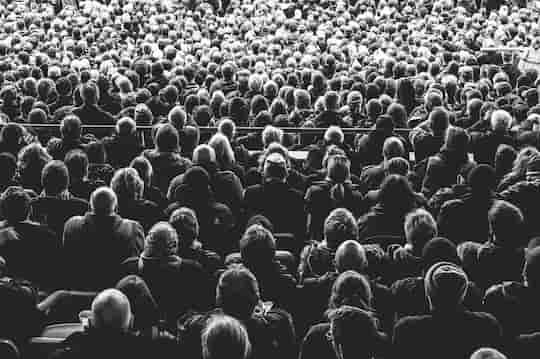
7 Myths of Crowd Psychology

Crowd

"The mass, whether it be a crowd or an army, is vile"
~Benito Mussolini

How do you imagine an archetypal crowd of people - say at a concert, a sporting event or a demonstration?

If you picture an irrational, spontaneous, suggestible, emotional and even potentially dangerous group then you are in good company.

Sociologists David Schweingruber and Ronald Wohlstein have found this view of crowds is promoted by many authors of introductory sociology textbooks. Indeed the idea that crowds demonstrate bizarre, almost pathological behaviour was championed by eminent French sociologist Gustave LeBon.

Despite these beliefs both in sociology textbooks and in the general public, the actual evidence does not support it. Crowds are not the many-armed destructive monsters of the popular or even fascist imagination.

Here are the seven myths about crowds that Schweingruber and Wohlstein identify, in order of how frequently they appear in introductory sociology textbooks.

1. Crowds are spontaneous

The most common myth about crowds is that they are spontaneous, or worse, that they are hotbeds of violence, with complete chaos only a few ill-judged jostles away.

Research into crowd violence does not support this. One study of riots shows that violence is normally related to the presence of two opposing factions. Mixed crowds - which are the norm - are in fact usually peaceful and only engage in stereotypical crowd-behaviour, e.g. whistling and clapping, face-painting, singing and shouting depending on the occasion.

In reality most people will go to almost any length to avoid actual violence, whether they are in a crowd or not.

2. Crowds are suggestible

The idea that people in crowds have heightened suggestibility is also a relatively common myth. People are said to copy each other, looking for a leader, being open to others' suggestion about how they should behave, perhaps resulting from a lack of social structure.

Schweingruber and Wohlstein simply find no research to back up this claim. If there is some truth to the idea that people in crowds are suggestible, no one has managed to demonstrate it empirically. One scholar has asked why, if crowds are so suggestible, they don't disperse when asked to do so by an authority figure.

3. Crowds are irrational

One type of irrationality frequently attributed to crowds is panic. Faced by emergency situations people are thought to suddenly behave like selfish animals, trampling others in the scramble to escape.

A long line of research into the way people behave in real emergency situations does not support this idea. Two examples are studies on underground station evacuations and the rapid, orderly way in which people evacuated the World Trade Center after the 9/11 terrorist attacks. Many lives were saved that day because people resisted the urge to panic. Resisting the urge to irrationality, or panic, is the norm.

4. Crowds increase anonymity

A less common myth, but still popular is the idea that people become more anonymous when they are in a crowd. This anonymity is said to feed into spontaneity and even destructiveness, helping to make crowds violent, dangerous places in which society's laws are transgressed.

Everyday experience, though, is that people usually travel in groups, with their family or friends, and so are not anonymous at all. Research confirms this, for example one study from the 70s found that most people at a football match were with one or more friends. Later research has repeated this finding.

5. Crowds are emotional

Less widespread this myth - nevertheless crowds are thought by some to be particularly emotional. It is argued that increased emotionality is linked to irrationality and perhaps violence.

Modern psychological research, though, doesn't see the emotions as separate to decision-making, but rather as an integral part. To talk about an 'emotional crowd' as opposed to a 'rational crowd', therefore, doesn't make sense. People in crowds make their decisions with input from their emotions, just as they do when they're not in a crowd.

6. Crowds are unanimous

Few of the sociology textbooks endorse the myth of unanimity, but the idea does appear that when people are together they tend to act in unison. Research suggests, though, that this is rarely the case - people remain stubbornly individual.

7. Crowds are destructive

The least common myth in the sociology textbooks, but quite a strong cultural stereotype of crowds, is that they are destructive. This is closely related to the myth of spontaneity and is often connected to violence.

Again Schweingruber and Wohlstein find that the research (like this) shows violence in crowds is extremely rare. And what violence does occur is normally carried out by a small minority - these are the people that make it onto the news.

What do you think?

Crowds obviously vary greatly, but this myth-busting portrayal of crowds certainly agrees with my experience. I assumed all the violent, despotic, spontaneous, dangerous crowds on TV and in films must be elsewhere.

What's your experience of being in a crowd or watching a crowd?

» This is part of a series on the psychology of the everyday.

[Image credit: twose]

  • Share/Bookmark

19 comments

  1. Alice says:

    At the Climate Camp at Heathrow last year, I saw amazing examples of peaceful but active and purposeful crowds.

    At the end of this clip the policeman is telling his superiors over the radio that colleagues were kicked and trampled, but I think this was an overreaction to the obvious humiliation that the police must have felt at having "lost" on this particular issue to the crowd.

    What I see is a very nervous crowd, with hands up, slowly pushing an unwelcome police presence out of their space. I know that most people in the crowd were scared that the police would lash out and start hitting with truncheons, but that they felt solidarity with others in the crowd (since all were gathered in a common purpose), the majority of whom would not have known each other beforehand.

    http://www.youtube.com/watch?v=Wfa15uT6V-Y

    For more context see http://www.climatecamp.org.uk/

  2. Alrenous says:

    I have often wondered if people are really so panicky as popular movies and books portray.

    It's nice to know that I was right.

    Now I have the urge to write a fantasy book where the people don't go insane at a mere glimpse of a dragon.

  3. tak says:

    I do agree that the belief that anonymity may translate into spontaneity and destructiveness in people when they are in a crowd is questionable.

    However, I disagree with your point of view that there is a lack of anonymity in crowds. While being in a group with friends and family members may indicate that they are known to one another in their small group, this does not mean that the group, as a whole, will not have the feeling of anonymity in a large crowd.

    Consider the case of attending a large function. We may go with a few friends, but we do get the feeling that no one else knows us personally and that we know no one else. This feeling, in my opinion, can only be described as feeling of anonymity.

  4. Marc says:

    I've been a musician, performer and teacher for 25 years and I agree that most people just don't want trouble, but they want to avoid to the extent that they would literally let other people in the crowd get away with murder; the sheep mentality; "I dont want to rock the boat." I saw this on Millenium Eve when about 5 or 6 people attacked an ambulance in the middle of a crowd of 1000s. It would have been easy for even a dozen people to overpower these idiots and save the occupants but 1000s of people simply stood and watched the whole thing.

  5. Kevin J Smith Jr says:

    Good summary, I immediately picked up my old soc.psych textbook to see what they (Brehm, Kassin, and Fein, 'Social Psychology', 6th ed) said. They associate crowds to violence via 'deindividuation' (chapter 8 is about group processes, page 273 begins the segment on the above), and open with the account of French scientists Gabriel Tarde (1890) and Gustave Le Bon (1895), who found crowd presence to be 'mesmerizing', and claimed that crowd participation could cause individuals to 'turn into copycat automatons, or worse still, uncontrollable mobs' (how is being in a mob worse than becoming an automaton?). They proceed to discuss with seriousness many of the myths you give an account of. I recall our class discussion took a similar turn. They do examine later work (Zimbardo '69, of course, Diener et al. 1976, Festinger et al. 1952). Would you say the researchers exaggerate reality, or the readers of the research and other similar papers are more responsible for the unnecessary extension? Or maybe, why not both?

  6. pseudo_facade says:

    I think there's much to be said about stereotypes here, but at the same times, a lot of these arguments seem to fall short of truly busting the myth.

    Really when looking at social behaviors, you will never be able to generalize all situations. Obviously there are crowds that are peaceful and that aren't effected by certain things as much as others, but it doesn't mean that most of the typical aspects don't apply at least in some small portion.

    I really like the argument discussing violence, as it identified the additional variables involved. It's important to acknowledge these aspects in the other cases as well. Otherwise you misinform, suggesting that these are full blown myths.

    The biggest stretch I found was with the anonymity. The argument was somewhat short sided, not acknowledging the fact that anonymity doesn't simply mean that no one knows you. Rather it's the "psychological" feeling that no one is paying attention to you specifically.

    With that in mind, clearly a group of friends from college will not by physically anonymous within their group, but to the outside, or any out groups, one person isn't singled out.

    The peer pressure is there, and is intensified, with the fear of standing out and losing that anonymity.

    In college, my professor noted a story of him standing in line for a movie. The line spanned across a street, and as it moved, he tried to stop at the curb, as to not block traffic. However, since everyone else was not paying attention, and going with the flow, it eventually felt too awkward to "hold up" the line by waiting at the curb.

    I think that is a great example of the influence of crowds and of at least a few of the points that have been declared myths.

    Perhaps a better title would be "7 Exaggerations of Crowd Psychology"

  7. JellyBlog says:

    Interesting, but I'm with pseudo_facade on this.

    While I agree on a some points I am certainly not reading 7 debunked 'myths' here in my opinion. In fact some crowded situations I have been in personally have shown me some of these 'myths' happening before my eyes.

  8. Gilbert Wesley Purdy says:

    Only a very limited amount of hard evidence is cited here. My personal experience makes me leery. I think you are a long way from making the case.

    I'm appending a few recent news items. They are only anecdotal evidence, of course, but their implications are worth considering. There were dozens more recent news items from which to choose. Add UK soccer fans to the list. Anonymous Internet mobs are mentioned below and beginning to be the subject of scientific studies.

    If the only condition one considers is a large group physically gathered together at some public entertainment event or public transportation facility in a wealthy country, I think it is reasonable to expect a different result than there would be if the ambient conditions were more generally provocative (if poverty, hunger, immaturity, frightening rumors, etc., were factors, for example). Of course, the prevalence of Internet wolf-packing suggests that the more convinced a member of a mob is that he or she is impenetrably anonymous, the less other immediate ambient conditions are necessary.

    Landslide rumours trigger stampede
    Pilgrims to Hindu temple trampled, fall to their deaths; Swelling Crowds...

    Geetinder Garewal, Reuters
    Published: Tuesday, August 05, 2008

    CHANDIGARH, INDIA - Indian authorities yesterday investigated possible causes of a stampede outside a mountaintop Hindu temple in northern India that killed at least 145 pilgrims.

    Nigerian jobseekers trampled to death
    Tue, 15 Jul 2008 03:43:24 GMT

    At least 30 people have died in a rampage as jobless Nigerians stormed the country's immigration center in hopes of finding employment.

    Ruckus at two hospitals, 8 held
    12 Aug 2008, 0434 hrs IST,TNN

    KOLKATA: Families went on the rampage at two city hospitals after the death of two patients on Monday. While the superintendent's room was ransacked at MR Bangur Hospital, panes were smashed at Devi Shetty's Rabindranath Tagore International Institute of Cardiac Sciences (RTIICS). Police detained eight people for the violence at Bangur....

    At RTIICS, irate family members of 35-year old Rajat Bhowmik — who passed away at 2.45 am — accused doctors of delaying his treatment. Glass panes at the hospital’s ground-floor were smashed. Around 7.30 am, a huge group entered the hospital carrying lathis. They first attacked the reception counter and smashed glass doors and furniture. A hospital ambulance was also damaged. The mob calmed down only after a team arrived from Jadavpur East PS.

    Nigeria: Mob Kills 50-Year-Old Man for 'Blasphemy'

    Daily Trust (Abuja)
    11 August 2008
    Posted to the web 11 August 2008

    Yusha'u A. Ibrahim
    Kano

    A 50-year-old Muslim man, who allegedly made a blasphemous statement against Prophet Muhammad, was beaten to death in Kano on Saturday.

    The man was killed at Sheka Aci Lafiya quarters when some angry Muslim youths besieged his house and beat him to a state of coma.

    Huffington Post
    Beth Arnold
    The New Colosseum: The Internet
    Posted August 11, 2008 11:10 AM (EST)

    So John and Elizabeth Edwards have become the latest sacrifices to the new Colosseum: the Internet. Thumbs down to John's for his extramarital affair with Rielle Hunter! Then the mob turned to Elizabeth. This sad situation may have actually happened to her, but she doesn't have the right to decide how to handle it herself. Thumbs down for Elizabeth! The mob has no respect for her decisions about her own private life. The blogosphere will support or condemn her, according to the dictates of its own mob-heated blood lust.

    BBC News
    Friday, 18 July 2008 16:34 UK

    Mob attacks officers over litter

    Two police officers were attacked by a mob in south London after they asked a 15-year-old girl to pick up her litter.

    One officer was dragged to the ground and kicked while the other was bitten by a girl who jumped on his back.

    Up to 30 people took part in the attack,...

  9. sulfura says:

    In my experience of crowds they have been very peaceful, if not polite. I think, while you are in a crowd you are not really aware of how big an entity you are, it still comes down to your interactions with the handful of people closest to you.

    I remember one year at a festival with a turn out of around 300 thousand people, as those 300 thousand people left, and all had to exit on foot via the same four lane bridge, a group of young men had stopped to help girls and children climb over an inconvenient concrete barrier.

    When I was helped over, one of the friends of my helper actually stood in front of me (back turned) so that the oncoming crowd wouldn't see up my skirt!

  10. GoldenBoy says:

    Anyone here ever been in an incipient riot or an actual riot? Any crowd, as is any individual, is dependent on its environment for its reactions.

  11. Willy says:

    I was involved in the Undie 500 riots in Dunedin, New Zealand which took place in August last year (check out YouTube for footage). 69 people were arrested and the riot made BBC World and CNN with vehicles being torched and around 80 individual fires lit. I've become fairly interested in the crowd psychology aspect ever since as there were many conflicting public views about the causes. I'm with pseudo_facade and jellyblog, behaviour is definately conditional and dependant on too many variables to group together and define accurately.

    I'm interested in what people think about the involvement of alcohol as this was considered a major factor by the authorities in the Undie 500 riots. Police were called after fires were lit and fire engines weren't able to get to them due to the density of the crowd and apparently some bottle throwing. This then allowed riot police to show up and all of a sudden the whole crowd dynamic changed as everyone's psyche went from being a crowd to being a riot as "what else were we meant to think once they turned up with helmets and shields" (a quote from one of those arrested). The demographic is definitely a factor as in these riots it was virtually all students aged between 18-25.

    Another interesting point is that mathematical algorithms are used by Fire engineers in buildings (to specify widths of corridors etc. for optimum evacuation times) and would be interesting to look at. They use assumptions about the way people behave which must be tied to some academic consensus about crowd mechanics. Perhaps they're simplified and don't consider the behavioural effects we're discussing as they would be difficult to define mathematically. I guess I'll have to ask someone about it...

    Anyway a lot of good points people have raised and interesting reading but I'm with someone like Harvard psychologist Steven Pinker who believes behaviour is conditional. Therefore there's no such thing as a violent crowd or a suggestible crowd, only crowds that may have more of a tendency to behave a certain way but it still depends on the conditions.

  12. jdotjdot89 says:

    Interesting--but this is all research done in Western, individualistic societies. I wonder if it holds true for more collectivist societies, like China.

  13. Caleb says:

    I have to agree that movies exaggerate crowd mentality. It seems that in every movie everyone except the hero panics.

    Crowds are merely suggestible characters in a story and never the complicated cluster fuck that it really is.

    I remember one time in a bar full of people, there were these two guys that started fighting. My immediate reaction was "sweet, let's watch a good ol bar fight.", then all of a sudden, the one guys girlfriend smoked the other guy with a beer bottle and blood started flowing everywhere.

    I immediately wanted to help, but wasn't close enough so yelled, "someone stop it.", and heard someone nearby repeat what I said.

    It was then that two different people grabbed the guys and separated them.

    I felt guilty for the blood lust at first, to wanting to see some action outside of the movies. I think a lot of people get that feeling and it's the same one that escalates in to the horrifying things that human kind has done.

    Maybe it just takes someone to speak up to snap others out of it. It's just one of the many complications of our dynamic human behavior.

    As a whole I think it's very hard to study. Trying to understand one human brain is hard enough.

  14. Ambra says:

    I have to admit, I was very disturbed reading these "myths" especially after hearing about the man killed in Walmart this previous black friday. I have found in my experience that every one of those supposed myths are indeed true. They may not apply to every single crowd out there, but they definitely apply to quite a few. Panic is equal to stupidity, and if a crowd panics it becomes incredibly stupid. For example, if someone in a crowd started screaming and yelling "run! run!" Even though no one in the crowd has a clue what is going on, their instincts of survival will propel them into action. And that action is usually panic leading to stupidity. And in my experiences, crowds can be very very stupid.

  15. Lucidology says:

    "One scholar has asked why, if crowds are so suggestible, they don't disperse when asked to do so by an authority figure."

    Crowds are suggestible to social proof. People follow what other people are doing. Numerous studies cited by Cialdini prove this.

» Comments are now closed on this post «

Archives