
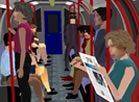
A new virtual reality study finds that 40% of the general population experienced paranoid thoughts during a tube ride. Dr Daniel Freeman at the Institute of Psychiatry in London and colleagues explain that while paranoid thoughts are popularly associated with mental illness, they are actually a normal part of everyday life for many of us.
In the study, which took place a year after the London tube bombings, 200 participants navigated a virtual reality simulation of a 4 minute journey on the London Underground. Avatars within the simulation were designed to react neutrally to participants moving through the simulation. Despite this, more than a third reported paranoid reactions like the following:
- ‘There was an aggressive person – his intention was to intimidate me and make me feel uneasy’
- ‘One guy looked pissed off and maybe one guy flicked the finger at me’
- ‘There was a man who tried to stare me out. But I didn’t give him any ammunition. Believe his intention was to start an argument’
Compare these to how other people experienced the simulation:
- ‘People were generally very friendly’
- ‘One guy was checking me out – flattering’
- ‘There were people smiling at you, which was nice’
This just underlines how people can experience exactly the same environment in completely different ways.
There’s a very good video on the Wellcome website with Dr Daniel Freeman explaining more about the study, how it was conducted and showing clips of the virtual reality environment.