
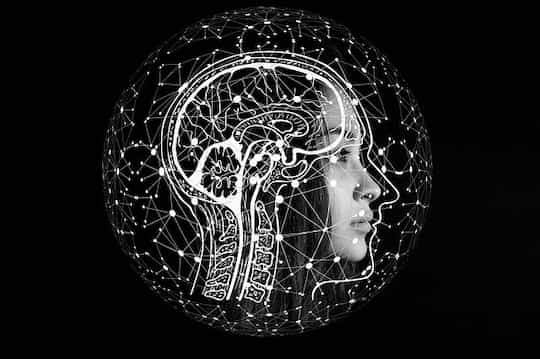
Seriously, Would You Admit to Only Using 10% of Your Brain?

Cycling

Mind-myth 1: Like many of the myths now seemingly fuelled by New Agers hoping to unlock the untapped, hidden forces that will unleash previously unimagined human potential, the 10% myth is a slippery customer.

Just when all the evidence has been marshalled against its original incarnation, showing that, yes, actually we do physically use all our brains, it turns out 'human potential' can't be measured empirically. Apparently the unused 90% is hidden below the surface, out of sight and almost out of mind. Which is convenient.

Let's start at the start.

The idea that we only use 10% of our brains is probably such an enduring myth because it's comforting to think we have spare capacity. The 'unused' 90% could take up the slack after brain injury or offer the possibility for miraculous self-improvement. This flexible factoid has been used not only to sell products to enhance our brain's performance, but also by psychics like Yuri Geller to explain mystical cutlery bending powers.

Boring, tedious, but unavoidable facts

Unfortunately there's four good reasons it's almost certainly false (Beyerstein, 1999):

  1. If we only use 10% of our brains then damage to some parts of our brains should have no effect on us. As any neurologist will tell you, this is patently not true.
  2. From an evolutionary perspective it is highly unlikely we developed a resource-guzzling organ, of which we only use 10%.
  3. Brain imaging such as CAT, PET and fMRI shows that even while asleep there aren't any areas of our brain that completely 'switch off'.
  4. Parts of the body that aren't used soon shrivel and die. Same goes for the brain. Any neurons we weren't using would soon shrivel and die.

The structure of the brain and its metabolic processes have also been carefully examined, along with the diseases that afflict it. None of this work has suggested there is a hidden 90% that we're not using. Unfortunately.

Anyone who still maintains we only use 10% of our brains after this fusillade of fact has to come up with a counter-argument for each one of these. Actually, you might argue that imaging technology is rubbish or the neurons are only working at 10% capacity, but refuting all four, taken together? Now that's tricky.

Mythical roots

The roots of this myth are very difficult to discern, probably because there are so many different, diffuse stories about its origin. One probably apocryphal story is that Einstein once explained his brilliance - compared to the rest of us mere mortals - by saying he actually used more than 10% of his brain (Wanjek, 2003). Despite probably being based on a misquote, the repeating of this story can't have hurt the myth's power.

Perhaps some of the earliest roots of the myth come from work by physiologists in the 1870s. They routinely applied electrical currents to the brain to see which muscles moved. They found that large parts of the human brain could be zapped without any corresponding bodily twitching. This led them to dub parts of the brain 'silent'. But they didn't mean silent in the sense of inactive, just that it didn't make any muscles move. Of course this didn't stop the phrase being misinterpreted.

The actual confirmed first written sightings of this myth, though, is in a 1940s advert for the book Cold Comfort Farm by Stella Gibbons (Wanjek, 2003, p.21):

"What's holding you back? Just one fact -- one scientific fact. That is all. Because, as Science says, you are using only one-tenth of your real brain-power!"

Whatever its provenance, the 10% myth is certainly a slippery customer. The reason is two-pronged: first, it's impossible to prove something doesn't exist and second, people like to believe it. If I say I've seen a Pegasus, or visited Mars, or that all our brains have huge untapped potential, you can't definitively prove me wrong. That's why, despite a few good solid blows to the head, this myth refuses to go down.

Perhaps putting it the other way around might deliver the knock-out blow. Instead of talking about the 90% of untapped potential, just ask people why they only use 10% of their brains. Would anyone seriously admit to that? I, for one, am working at maximum capacity. Well, most of the time anyway...

» Find out if any other mind-myths catch you out.

[Image credit: Clint M Chilcott]

References

Beyerstein, B. L. (1999). Pseudoscience and the brain: tuners and tonics for aspiring superhumans. In: S. Della Sala (Ed.). Mind myths: Exploring popular assumptions about the mind and brain. London: John Wiley & Sons.

Wanjek, C. (2003). Bad medicine: misconceptions and misuses revealed, from distance healing to vitamin o. London: John Wiley & Sons.

  • Share/Save/Bookmark

28 comments

  1. rx says:

    I don't disagree with you but, in my opinion, such debates are not scientific at all, and refering to science is just a rhetorical trick. This assertion just lacks definition for all the terms it uses. Building an opinion on such bases is just a question of taste - what position you prefer to defend. Then you are free to twist the definitions to fit your thesis and voilĂ , you are right.

    For example, it is almost certain that any single person uses far less than 10% of the biologically possibile states of interconnexions between its neurons, along its life. Does this make the initial assertion true ?

    Yet, your arguments are cool to face non-scientific defenders of the 10% use the brain theory defenders.

  2. Jeremy (PsyBlog author) says:

    Dr Howard, I'm not sure if you're joking!

    Eric, as commenters here have so ably pointed out the '10% myth' can be redefined and massaged so that it is true. The myth is badly defined and open to multiple interpretations precisely because it's not based on any science! So, in that sense, I agree with you.

  3. rhiannon-ruth says:

    I think that Joe public (being one of them lol) are strangely comforted by this theory.. or myth whichever way you prefer! That leaves a good 90% unnacounted for. We are then free to attribute unexplained human behavior down to the grey matter that we no nothing about. Murder, religous zeal, psychic mediums, super human strength. the list goes on... But the truth of the "matter" (haha excuse the pun) is, that although we can now say, "right, this neuron does this...and if we tweak that bit.. we can make him drool.. way hey.." We dont really KNOW. So until every square inch of the brain is accounted for(then we've still got the subconcious brain to think of and the alpha state that pychics believe they can tap into) we cannot completely prove, nor completely dispell the 10% myth.
    However.. i personally have never really taken the percentages seriously.. I always believed it just referred metaphorically to the fact that the brain is a complex organ and there may well be things we will never know about the workings within it. :) Brilliant article though, very thought provoking.

  4. garrett says:

    i'm not sure why nobody has mentioned glia yet, but they seem to be the most likely source of the 10% myth.

    From Wikipedia:

    "The human brain contains about ten times more glial cells than neurons.[1] Following its discovery in the late 19th century, this fact underwent significant media distortion, emerging as the famous myth claiming that "we are using only 10% of our brain". The role of glial cells as managers of communications in the synapse gap, thus modifying learning pace, has been discovered only very recently (2004)."

    This would be a very clear motivation for the myth, and the misinterpretation is also clear--people got the idea that the glia were somehow inert and unimportant, whereas the neurons were being actively used for thinking. now it is recognized that glia cells also perform vital functions.

    it's kind of like claiming that we only use a certain percentage of our body for sports, nowhere near our full potential, because we waste space with such things as blood vessels and organs...

  5. garrett says:

    also, all you need to do to debunk the 10% myth is to say "neurologists and cognitive scientists agree that there is no evidence that we use only 10% of our brain, in any sense"

    i think that most people who hear the myth think there is some scientific study out there that supports it. there isn't. basta.

  6. rufsketch1 says:

    perhaps the myth comes from a misinterpretation of us being conscious of the processes of only a small part of our brain? (we have no clue how exactly we seem to know that one apple is less than two apples, or how all together they make 3 apples).

  7. chrislehrich says:

    It strikes me that a great deal of the motivation behind this myth is not so much that people believe there is, as one commenter put it, "some study out there that shows" it to be true; rather, many people want to believe that Science (here treated as a monolithic entity) doesn't understand something and doesn't want you to know it.

    To expand, then, the myth in one of its classic formulations (e.g. Pauwels & Bergier, Le matin des magiciens [The Morning of the Magicians]) goes something like this:

    1) The best neurological information we have today is utterly unable to account for the workings of 90% of the brain. [sort of true, if we're talking about the 1940s or so, if we define things loosely]

    2) This means that 90% of the brain's power and potential is beyond the knowledge of science. [rather less true, but still sort of arguable mid-century]

    3) This is not because science doesn't know but because science, in its current state, is incapable of knowing these things. [actually quite true, if we take the "current state of science" to mean the technical state of neuroscience mid-century]

    4) This is because science refuses to acknowledge that which is beyond its current ken. [exceedingly problematic as a generalization]

    5) In fact, science doesn't want you to know about this higher potential. [moving into the insane as a generalization: science is not a continuous entity with a will]

    6) This is why science also ridicules things like telepathy, telekinesis, and so on, all of which are demonstrably real. [no, they're not]

    7) In fact, these things are done with parts of that special, hidden 90% of the brain, and some people have evolved just a hair beyond the rest of us and can make active use of this portion of the brain. [does not at all accord with the previous, much more limited claims about the 90%]

    So it all rests on a crucial bit of fallacious logic:

    A) Neuroscientists at X time have an imperfect, incomplete knowledge of the total function and capacity of the brain. [true]

    B) That part of the total function which neuroscientists do not fully understand must do something whose very function is outside the normal realm of accepted science. [false inference]

  8. Kalli says:

    I suspect the original copywriter - or even the original "press releases" about any such findings - confused 'brain' with MIND.

    I have no doubt that, as far as it is observable, most people seem to use a minute portion of their mind.

    The equation "mind = brain" is the real myth.

    And the fact that it still persists to this day is a real tragedy...

  9. jenny(psychgirl) says:

    hi,
    i agree with those who said that it is just a myth....i dont really think so that there's a scientific basis with this.
    the important is how could we prove that only 10% of our brain are we only used?
    in my own opinion,i think its depend upon the situation how you understand the question.
    example we could say that it is true because some people believe that,while the other parts of our brain is active,the other parts are inactive.because if it works 100% at the same time,maybe we could be get mad.are they saying that when we sleep,some parts of our brain doesnt work?is that what they mean?
    well,for me i believe that all the time our brain 100% working.our brain consist of diff.structure with diff.functions...
    lets say,when we are planning,reasoning,thinking,or percieving,it means our cerebral cortex is functions.pons,when we are sleeping or arousal.medulla oblongata,regulates our heartbeat,breathing,and blood pressure.all of that parts of our brain,are,we really needed in everyday of our lives.
    even the lobes of our brain has a quite diff.functions.
    so,how could you say that only 10% of our brain is just working?did you already know the diff. parts and functions of our brain?
    i really beleive that,if one 1% percent of our brain doesnt work,then we could say that there is something wrong inside of it.
    how much more if 10% doesnt work?i think im gonna loose my sight...=)

  10. tinalovespanic says:

    Okay so my friends and i came up with this theory.
    Apparently when you are a baby it is claimed that you know everything or at least a lot,
    so if that happened maybe that other 90% was used as a baby but eventually we became to forget things or know less. As we got older the precentage of our brains used decreased and now we use 10% at this stage in our lives. And it is in a stable condition of 10% usage until we receive trauma, injury, or becoming ill and eventually die. Could This Really Be Possible?

  11. Serena says:

    This myth is true, yet untrue. This "unused" 90% of our brains is used, but in an involuntary way, such as storing inactive long term memories, contolling temperature, and even determining personality. Therefore, the brain is efficient, yet we cannot enhance brain activity with the self-controlling parts of our brains, nor can we use these to take over for injured or diseased tissue. Also, if zapped, these parts of the brain have unnoticble effects on the body.

  12. Bronson says:

    Too many people here are rationalising the myth by stating that only 10% of our brain is used for conscious mental activities. I see no reason why this might be the case however.

    It is plausible that we only consciously use 10% of our brain but I don't know how this could be estimated since we still don't know what constitutes conscious mental acitivty. Scientists and philosiphers are still arguing over what is conscious and what is unconscious (if it exists), and how these states relate to the brain (not to mention whether there are there different types of consciousness e.g., phenomenal & access). For example, is it right that only what we can talk about is conscious (a position put forward by Sperry)? If that is the case only Broca's area and Wernike's area are conscious the rest is unconscious. But then that leaves out vision, the experience of pain etc as conscious experiences doesn't it. Moreover, it rules out the right hemisphere which is 'mute'. A person with a left hemisphere removed does not become an unconscious zombie, they just can't talk, and they still experimence the world consciously through their intact right hemisphere. But this is exactly the debate currently going on in cognitive science between Koch, Lamme and Deheane (among others).

    So even if we had a perfect understanding of how mental states related to the brain, we still couldn't give an estimate regarding which parts (or activities) relate to conscious and unconscious effects because we still don't know which mental activities are conscious, unconscious, preconscious, access consciousness, phenomenal consciousness etc.

    Lets use a concrete example. Deheane's global workspace model of consciousness argues that there are a population of neurons spread throughout the brain which are responsable for conscious mental activity. According to his theory only these neurons would constitute conscious bits of the brain, all we have to do is locate them, and then we would have our estimate. Conversely, Lamme argues that conscious mental activity arises from feedback connections from 'higher' to 'lower' parts of cortical processing. Because these types of neural connections are everywhere in the brain this means that 100% of the cortex (and probably most of the whole brain) is used consciously.

    So make whatever story you want up out of the theories I just described but what I'm getting at is that there is no consensus regarding what exactly constitutes conscious neural activity. Without this consensus, using an single figure to denonte how much of the brain is used consciously is nonsense because different theories would predict different numbers.

  13. cyleleghorn says:

    ok, 1. the 10% of our brain that we do use for thinking is spread throughout the entire brain, although we use more like 20%. it isn't just shoved into one corner. 2. We only consciously use 20 percent. the other 80 is busy doing other things like making out heart beat and getting us to breath and storing instincts. 3. Who ever said part of our brains switched off?? if they did, we would probably die in our sleep, or suffer brain damage if we slept for more than 3 hours. and 4. All of our brain is being used, just not for mental conscious thought. if we could figure out how to use more of our brain, like say, 75 percent, the possibilities are endless. we need a partition editor for our brains. we need to decrease the size of our brain used for instincts and organ control, because seriously, it doesn't take that much power, and expand the amount that we can use for mental calculation.

» Comments are now closed on this post «

PsyBlog Archives