

How to Avoid a Bad Bargain: Don't Threaten

Threatening Fist
[Photo by Dplanet]
An award-winning social psychology experiment reveals why we often fail to bargain effectively with each other. This deceptively simple experiment examines the effect of two vital aspects of bargaining: threat and communication.

Bargaining is one of those activities we often engage in without quite realising it. It doesn't just happen in the boardroom, or when we ask our boss for a raise or down at the market, it happens every time we want to reach an agreement with someone. This agreement could be as simple as choosing a restaurant with a friend, or deciding which TV channel to watch. At the other end of the scale, bargaining can affect the fate of nations.

Big-scale or small-scale, bargaining is a central part of our lives. Understanding the psychological processes involved in bargaining can provide us with huge benefits in our everyday lives. In a classic, award-winning series of studies, Morgan Deutsch and Robert Krauss investigated two central factors in bargaining: how we communicate with each other and how we use threats (Deutsch & Krauss, 1962).

To do this, they used a game which forces two people to bargain with each other. Although Deutsch and Krauss used a series of different conditions - nine in fact - once you understand the basic game, all the conditions are only slight variations.

So, imagine you were a clerical worker at the Bell Telephone Laboratories in the late 1950s and you've been asked to take part in a psychology study. Every psychology study has a story, and this one revolves around two trucking companies...

Experiment 1: Keep on trucking


Before the experiment proper starts, the researcher explains that you'll be playing a game against another participant. In the game you will run a trucking company. The object of the game is the same as a real trucking company: to make as much money as possible.

Like the real-life trucking company you have to deliver as many of your goods as possible to their destination in the shortest possible time. But in this game you only have one starting point, one destination and one competitor. It looks like a pretty simple game.

Here's the catch.

The road map your one truck has to travel across presents you with a dilemma. You are the 'Acme' trucking company and your fellow participant is the 'Bolt' trucking company, although both of you have an identical problem. Have a look below.
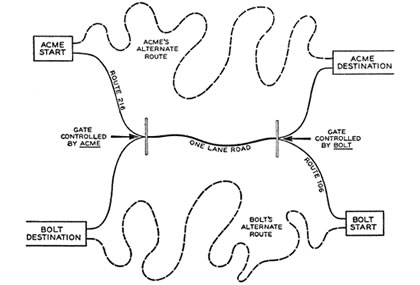
Cycling
[Deutsch & Krauss, 1962, p. 55]


As you'll see there are two possible routes you can take from the start to your destination: the short and the long. Remember, time is money, so the longer it takes you to get to your destination, the less profit you make, which is the aim of the game. Unfortunately the short route has a major shortcoming: it is one-way. Only one of you can travel down it at a time towards your destination.

It seems you'll be forced to work out some agreement with your unknown rival to share this one-way route so that you can both make money. How you'll do this is another mystery, though, as there is going to be no communication between the two of you during the experiment. You are to be seated in a cubicle from where you'll only be able to see the control box for your 'truck' and the experimenter.

Threatening gates


You are to be given one method of communication with your rival, albeit indirect communication. Each of you controls a gate at your own end of the one-way road. The gate, though, can only be closed when your truck is on the main route. This will be your threat. It is reinforced by the experimenter that you are out to make as much money as you can for yourself - the other person's profit is not a concern.

On your marks, set, cooperate!


Once the experimenter sets you off, it soon becomes clear you're not going to make much money at all. In the first of 20 trials, both you and your rival shut your gates, forcing both trucks onto the alternative route. This is 50% longer and means you make a loss on the trip as a whole. In the second trial your trucks meet head-on travelling up the one-way road. You both have to reverse, costing you time and money.

The rest of the trials aren't much better. Occasionally you make a profit on a trip but more often than not it's a bust. You spend more time on the long route or reversing than you do chugging happily along the main route making money.

At the end of the experiment, the researcher announces how much profit you made. None. In fact you made a crippling loss. Perhaps trucking companies aren't so easy to run.

Comparing threats


You find out later that you were in one of three experimental conditions. The only differences in the other two conditions were that in one there were no gates at either end of the one-way road. In the other there was only one active gate controlled by one player.

Before I tell you the results of the other two conditions, try to guess. One condition, which you've taken part in, contained bilateral threat - you could both threaten each other. One condition had unilateral threat - only one could threaten the other. And the final condition had no threat at all. What was the order of profit?

In fact it turns out that your condition, of bilateral threat, made the least profit when both participant's scores were added up. The next most profitable was the unilateral threat condition, while the most profitable overall was the no-threat condition.

Here's the first rather curious result. While the person who had the threat - control of the gate - in the unilateral condition did better than the person who didn't, they were still better off, individually and collectively, than if they both had threats. What this experiment is showing is that the availability of threats leads to worse outcomes to the extent that unilateral threat is preferable to bilateral threat to both parties.

Experiment 2: Lines of communication


But surely a little communication goes a long way? You weren't allowed to talk to the other participant in this experiment, so your trucks had to do the talking for you. Bargaining is all about reaching a compromise through negotiation - surely this should help?

To test the effect of communication Deutsch and Krauss (1962) set up a second experiment which was identical in all respects to the first except participants were given headphones to talk to each other.

Here's the next curious result: allowing the two participants to communicate with each other made no significant difference to the amount of money each trucking company made. In fact the experimenters found no relationship between words spoken and money made. In other words those who communicated more did not manage to reach a better understanding with each other.

Like the experimenters themselves, I find this result surprising. Surely allowing people to communicate let's them work out a way for them both to make money? And yet this isn't what happened in the experiment at all. Instead it seems that people's competitive orientation was stronger than their motivation to communicate. On the other hand, perhaps something specific to the situation in this experiment is stopping people talking?

Participants in the second study reported that it was difficult to start talking to the other person, who was effectively a stranger. As a result they were considerably less talkative than normal. Could it be that it was this situational constraint that meant little talking, and therefore little bargaining was going on?

Experiment 3: Forced communication


Deutsch and Krauss decided to test the effect of forced communication in their third experiment. Again the procedure is the same as last time but now participants are instructed that on each of the 20 trials they have to say something. If they don't talk on one of the trials they are gently reminded by the experimenter to do so. They are told they can talk about whatever they like, as long as they say something.

The results finally showed some success for communication. Performance in the one-gate (unilateral threat) condition came close to that achieved in the 'no-threat' condition (remember the no-threat condition has the best outcomes). Forced communication didn't have much effect on the 'no-threat' condition when compared with no communication, and neither did it improve the bilateral threat condition much. It still seems that people are so competitive when they both have threats it's very difficult to avoid both sides losing out.

Threat causes resentment


The most surprising finding of this study is how badly people do under conditions of bilateral threat. In this experiment not even forcing communication can overcome people's competitive streaks. Deutsch and Krauss provide a fascinating explanation for this.

Imagine your neighbour asks you to water their plants while they're on holiday Socially, it looks good for you if you agree to do it. On the other hand if they ask you to water their plants otherwise they'll set their TV on full blast while they're on holiday, it immediately gets your hackles up. Suddenly you resent them. Giving in when there is no threat is seen by other people as pro-social. Duress, however, seems to make people dig in their heels.

Applying the brakes


Before drawing some general conclusions from these studies, we should acknowledge the particular circumstances of this research. Deutsch and Krauss's experiment covers a situation in which bargaining is carried out under time pressure. Recall that the longer participants take to negotiate, the less money they make. In real life, time isn't always of the essence.

The present game also has a relatively simple solution: participants make the most profit if they share the one-way road. In reality, solutions are rarely that clear-cut. Finally, our participants were not professional negotiators, they were clerical and supervisory workers without special training.

Real-life implications


Despite these problems the trucking game has the advantage of being what game theorists call a non-zero-sum game. In other words if you win, it doesn't automatically mean the other person loses. When you total the final results, as you sometimes can in a financial sense, they don't add to zero. In real life many of the situations in which we find ourselves are of this nature. Cooperation can open the way to more profit, in financial or other form, for both parties.

As a result the trucking game has clear implications for real life:
  • Cooperative relationships are likely to be much more beneficial overall than competitive relationships. Before you go 'duh!', remember that increasing proportions of the world's societies are capitalist. Deutsch and Krauss's experiment clearly shows the friction caused by competitive relationships, such as those encouraged by capitalism. I'm not saying capitalism is bad, I'm just saying competition isn't always good. This simple fact is often forgotten.
  • Just because people can communicate, doesn't mean they will - even if it is to their advantage.
  • Forcing parties to communicate, even if they already have the means to communicate, encourages mutually beneficial outcomes.
  • In competitive relationships, communication should be aimed at increasing cooperation. Other methods will probably create more heat than light.
  • Threats are dangerous, not only to other's interests, but also to our own.

Remember all these the next time you are bargaining with your partner over a night out, about to shout a threat at a motorist blocking your path on a one-way road, or even involved in high-level political negotiations between warring factions with nuclear capabilities. It could save you, and the other side, a lot of trouble.

Have your say


Why not let everyone know what you think of this experiment. Are you surprised by the findings? Do you think it applies to real life? Does it make you reflect on how you bargain any differently? Or anything else you'd like to bring up. Whether you're a psychologist or a lay-person, do pitch in with your point of view. Remember you can now also get follow-up comments by email.

» Discover more of the best studies in social psychology.

» If you enjoyed this post, subscribe to PsyBlog (RSS).


Reference

Deutsch, M., & Krauss, R. M. (1962). Studies of Interpersonal Bargaining. The Journal of Conflict Resolution, 6(1), 52-76.

Labels:

Like this post?

28 comments

Anonymous Eric on 29/10/07 1:06 AM 

Really interesting! It was great to discover this blog, keep up the good work.

Blogger Jeremy Dean on 30/10/07 8:18 PM 

Thanks Eric, glad you enjoyed it.

Anonymous letiantu on 31/10/07 3:01 AM 

my question:
Are the same crowds of participants take part in all three experiments ,or three different groups of people to do them?
In the other words ,former memory of the experience may help them perform better in the next time.

Blogger Jeremy Dean on 31/10/07 9:31 AM 

Letiantu, different participants every time - otherwise you're right, memory would give them an advantage.

Anonymous Stephan on 2/11/07 3:23 AM 

This generally leaves me wondering. would being able to apply a face or some sort of an identity to the other person effect your willingness to co-operate with them or does the idea and knowing there's a person have the same result?

Blogger Jeremy Dean on 2/11/07 8:12 AM 

Stephan, yes, I'm sure that would make a difference. In this particular study they wanted to cut that variable out though.

Blogger steven on 6/11/07 5:40 PM 

So I'd like to see this experiment.

In experiment one where both have a gate, what would happen if one guy dismantled his gate or left it open at all times?

Blogger Jeremy Dean on 6/11/07 6:27 PM 

Steven, I think you're describing the unilateral threat situation which I've covered in the post.

Anonymous Anonymous on 14/11/07 2:15 AM 

Not a bad analysis, however in your analysis you make the comment that capitalism fosters competition. While this has elements of truth it underestimates the intense level of cooperation it fosters and encourages. The amount of cooperation required for any business is astronomical.

Blogger Ben on 14/11/07 1:12 PM 

Very interesting (as are the other studies)!

One thing I find unclear, or a little deceptive, is the claim that the unilateral threat situation was less beneficial than the no-threat situation.

I can see how that is the case when you consider both parties together, i.e. the total amount of money made, but was it also the case if you just consider the one with the unilateral threat?

And if so, is that because the other actually has a threat, namely, sending a truck along the main road? Otherwise, I don't see how the player with unilateral control over the better route can lose out over one who shares it, and the conclusion is a little misleading.

Anonymous erin on 14/11/07 1:27 PM 

I have been very much enjoying your blog, and am glad I found it (through reddit). I just wanted to say something about the capitalism comment... I think you are assuming that the alternative to capitalism is something that is without threat. As I see it, it is actually the other way around. Capitalism gives people the freedom to choose what they do, and co-operate with each other, whereas the alternative requires a body (ie, government) to use threat and force to regulate.

Blogger Jeremy Dean on 14/11/07 8:06 PM 

Anon, good point - otherwise capitalism would be completely unworkable - but see my reply to Erin below.

Ben, surprisingly this experiment found that if the other person has a threat, you are better off without a threat than with one. Both people having a threat leads to the worst outcomes for you as well. I know it's counter-intuitive but that's what they found.

Erin, glad you're enjoying it! My reply to your point would be that we're not in an 'either-or' situation. Even within a capitalist society there is a spectrum running from dog-eat-dog competition down to highly regulated environments. I suppose I would have been better to refer to the 'worst excesses of capitalism' rather than just capitalism per se.

Anonymous john on 17/11/07 3:32 PM 

What if there were a real prize for the participants? Like a small share of the profits?

Blogger DaveT on 29/11/07 10:16 PM 

The remarks about capitalism are silly and uninformed. Perhaps they even indicate a political bias in the writer.

The whole point of capitalism is that businesses compete for the attention of customers. The competition helps customers forcing each business to keep a minimum of profits for itself, assuming there is adequate competition (hence monopoly laws).

Sure, if businesses cooperate, they can do all kinds of neat things, like price-fixing, that help them out a lot, but this is bad for the consumer (hence it's illegal).

Of course, this is a simplified view. Real-life is far more complicated. The businesses would cooperate as much as the law lets them (assuming it is in their mutual best interest) so that they would intelligently use the road, and then make more profits. However, if one business had more capital, they might shut the road down and use the alternate route until the first business has to quit. Then they could have the road all to themselves.

Of course, if they aren't price-fixing, the lower cost of shipping would eventually make its way to consumers via cheaper prices or added value of another kind.

And that's the whole point of capitalism. The environment for businesses is cutthroat. Do the math for starting a business and it almost looks impossible. Especially when competing against chains. But local businesses that succeed find some way to offset their higher operating costs with a particular local "flavor". Or else they fail. That happens a lot too.

In capitalism, competition helps the consumer not the business. Competition is merely the environment which allows individuals to own and operate a business at their whim as long as they can compete.

Anonymous Kevin on 20/12/07 5:38 AM 

As the poster said in an earlier comment, Davet, he's not strictly speaking of an either-or situation. Capitalism itself isn't bad, but this 'cutthroat reality' of business is very much unhealthy for all parties involved.

A certain level of competition is healthy and natural, and this sort of thing is very good for business and consumers. But the sort of unethical business practices that extremist capitalism, as you call it, a 'cutthroat business environment,' is only, again, harmful. When things get so gritty and unethical that you've got food conglomerates bribing the FDA so they can make cheaper, potentially dangerous products, you've got a problem on your hands for everyone involved. When companies get so competitive you've got ruthless near monopolies going and cutting the jobs out from under from thousands of hard working folks, well... Hard as it is for some folks to hear, the individual does better when everyone does better.

Which is part of the message. The idea of competition and being concerned primarily with your own profit isn't really the issue. It's a lack of foresight, tipping the scales from simple, healthy competition towards a destructive appetite for no-holds-barred victory.

Yes, I do realize it's simple to say that it's fine and reasonable for companies to do whatever necessary in their own self interest, and that it's a healthy example of capitalism. Unfortunately, the reality of the situation is that corporations that don't consider the long term effects of their actions are only doing themselves in in the end and taking everyone else with them. Yes, it might seem simple to downgrade to cheaper synthetic preservatives and buy out competitors to increase profit, but when half of a nation suffers all manners of maladies twenty years later and you've got millions of previous proud small business owners and workers turned into miserable cogs in a huge cash machine, what's your profit going to matter then? Will people be spending liberally when they're sick and miserable? Will anyone even trust you anymore?

And, I believe, that is the point of this study. Not that simple capitalism or competition is 'bad.' But that undue aggression and unethical means to an end are simply bad business for everyone involved at the end of the day.

Anonymous nuv on 20/12/07 6:47 PM 

This study really has no bearing on capitalism; as davet pointed out, captitalism involves a third party, the consumer.

The consumer of course has their own threat; do they or do they not purchase the product, and if so, from whom. However, the choice to not purchase may or may not be detrimental.

The results of such a study would be quite interesting.

Anonymous Kevin on 21/12/07 12:08 AM 

Nuv, I don't think a potential purchase could be called a threat in any form, really. A vote, yes, but a threat? Not especially. The threats defined in this unarticle are untowards aggression that seek to control a situation directly. A purchase is based entirely around a simple choice that will indirectly control business, but there is no aggression or force, simply a win or lose scenario based on a matter of choice and not power.

Yes, capitalism involves the consumer whereas the study does not, but the article still applies heavily to competition between companies in a capitalist situation. Aggression coupled with the illusion of success exists and works the same whether customers are involved or not. Whereas in the example trucking companies competed to use an efficient route, choosing between threatening the competition for greater percieved profit or working together in a more ethical and ultimately profitable fashion, an example involving, say, a car company would see them competing for profit by aiming for the same customers (which is highly parallel to the efficient route,) choosing to agree to a healthy competition and division of resources, taking only what they've rightfully earned, or opting instead for percieved greater profit through aggressive undercutting and manufacturing shoddy goods in the hopes of quicker short term gain.

While we might want to say that customers comprise some wholly cogniscient third party in capitalism, the end result is much more akin to the trucking example. Customers are simply the source of that profit, and in the same way that there are set in stone ways to access the bridge in the example, there are also similarly concrete ways to profit from most customers. Quality/amount VS price (or, in this sad age of low consumer responsibility, simply price,) is a flat formula that translates into profit. Companies can fight fairly, determining success by quality of work, sharing customers, or bridges, equally except for those rightfully earned by having a superior product, or they can be destructively aggressive and determine short term gain by doing unethical business to tread where competitors shouldn't or can't.

The only real difference is time span. The study is a good example because it shows the truth in the short run; whereas unethical, aggressive business involving consumers can take years for the real effects to come to light. Both trucking companies shutting down their sides of the road will prove unprofitable quickly, whereas both car companies producing shoddy work will take a few years for folks to figure out exactly what's going on.

Anonymous John on 22/1/08 2:08 AM 

Really enjoyed my time on this blog. I will definatley be a regular visitor. You have me hooked after one visit.
Well Done.

Anonymous Anonymous on 25/1/08 12:35 PM 

Thanks for posting this, I found it quite intriguing.

Something about the surprising results haunted me tonight when I went to bed after reading about this, though. I got out of bed just to post this, though I admit I am uncomfortable doing so, since it runs rather contrary to how I usually think of myself.

"Turn the other cheek" makes a lot more sense in light of the findings in this experiment. Think about it. When just one side used threats and the other did not the outcome was better for both than if both had. I don't mean to come off like some religious nut, I'm just saying. What DOES it mean that someone 2,000 years ago apparently grasped the surprising aspects of the concepts embodied in this study ?

Anonymous Judy on 15/2/08 2:02 PM 

Since men -- in general -- tend to be more competitive and make fewer connections with talk, and women -- in general -- tend to be more cooperative and make more connections with talk, I wonder what percentage of the two sexes were represented in the experiment? And if women were underrepresented, what would happen if they were equally represented, or over?

OpenID ksgarvin on 17/3/08 5:49 PM 

I'm wondering if the players were more aggressive than they would be in real life because they knew they were playing a game. Is there any way for researchers to test for that kind of behavioral modification?

Blogger Kypi on 20/3/08 9:51 PM 

Steven said he would like to see the experiment where one person either removes his gate or leaves it open the entire time.
I do not believe this is the same as unilateral threat, for unlike having no threat to begin with,the person gives up his threat, which could yield much different results than expected.

OpenID feminazi on 15/5/08 3:54 AM 

So it's kind of silly for me to assume I found a flaw in a 50 year old peer-reviewed study, but I'm not sure this thing measures what it claims to.

It claims to measure cooperation and bargaining. It claims that the participants are not in competion with each other. It claims that the participants realize they are not in competition with each other.

But that cannot be true. From this sentence: "In the first of 20 trials, both you and your rival shut your gates, forcing both trucks onto the alternative route."

If the participants do not feel as if they are in competition with each other, then there is no reason to impose a handicap on anyone else by locking the other person out of the gate. They would simply wait their turn on the one-way road, or both go in the same direction at the same time.

I do not understand this experiment; it makes no sense to me. If the goal is to make as much money in the shortest period of time regardless of what the other person does or doesn't do, then yes, the other person is merely an irritant -- not a direct competitor.

Why the assumption that an irritant does not equal competition? In practical applications, this distinction becomes meaningless. The guy who makes it difficult for me to do my work, without any benefit to him whem my job becomes harder, is as much of a problem to me as the guy who does receive a benefit from making my job harder. I don't care what his motives are; the result to me is the same. So the participants in this study ARE in competition with each other.

Perhaps that is merely a minor nitpik, but I'm not so sure. After all, the researchers claim to exempt competition from the framework of the study.

That is one problem, but there is another.

Obviously the most efficient way to maximize one's own profit is to share the space, but none of these morons want to do that initially. They want to make life difficult for the other person just for the sheer fun of it. Each participant is assuming that the other person will abuse the power in that person's possession; and in order to mitigate this situation, each participant decides to abuse his own. Remember, it is the researchers who are claiming no competiton exists.

The premise of this study isn't examplified in real life under practical applications. If a criminal threatens me with a gun, he may back down when I brandish my own weapon. Or he may choose to escalate and shoot at me. Or he may choose to not approach me at all, if he realizes that I am armed.

We know from many criminal justice studies that criminals prefer attacking unarmed opponents; rarely do they choose to attack an equal when a less armed person has the identically desired object.

This study claims that the best outcome occurs when only one person has the greatest advantage -- hogwash in real life. When only one group has the advantage, other groups tend to get screwed.

In the unilateral example, the person with all the power wins the most profit, and the loser still does okay. We are supposed to forget that the winner in this particular scenario has no motive for inflicting additional harms onto the other person.

Where is that study on cognitive dissonance? The researchers wanted to prove that it is okay for one group to have all the power, and so they hope we only look at the winner -- and forget that the loser even exists. Which is why someone mentions capitalism; we're supposed to forget all about the people oppressed by megarich superpower corporations.

Blogger Austin on 8/6/08 11:48 PM 

feminazi, you claim that the participants could "both go in the same direction at the same time". What are you talking about? It's a one-lane road, and the participants need to travel in opposite directions. When one truck gets on that road, it makes that road unavailable to the other truck until the first truck leaves it -- and that one-lane road makes up at least a third of the main route! If one truck allowed the other to go first, that first truck would lose out in a big way on travel time, as they have to sit and wait for the other truck to emerge. It is hardly trivial to work out a mutually-agreeable bargain from this situation, especially when you are two strangers who can't speak to one another directly (or who are reluctant to do so). The obvious solution is to take turns being the first to enter the middle road, but who "goes first" first? What if one side cheats once, going out of turn? Did they just forget or are they "pretending" to forget? And despite all these problems, the "no-gates" pairs did very well.

You also say that "the researchers...are claiming no competiton exists."
Where do the researchers claim such a thing? I admit I don't have access to all of the original study, but in this article it's explicitly stated that "in this game you only have one starting point, one destination and one competitor" and that "you'll be playing a game against another participant" (emphasis mine). The article does state that this is an example of a non-zero-sum game, where one side's win does not necessarily mean a loss for the other, but that hardly excludes competition. And yes, the other person's profit "is not a concern," but their access to the middle road certainly is -- that was the whole point of the experiment. They "cooperated" only to the extent that they cut down on one another's interference with each other.
The first page of the original paper, available at http://www.jstor.org/pss/172878, states that one of the essential features of a bargaining situation -- i.e. what they were studying -- is that both parties recognize that they have "conflicting preferences" or "opposed interests" (Deutsch & Krauss 1962). (I cited my paraphrase. Please don't hit me.) According to their very own definition, the researchers would not have been able to study bargaining if the participants were not in conflict and/or did not believe that they were in conflict.

The "non-zero-sum" game classification does, however, mean that your example of a criminal robbing someone at gunpoint does not apply to this experiment or to the conclusions drawn from it. When a criminal directly robs another person, that's a "zero-sum" game: everything one person wins is at the direct expense of another person. It is also not a very good practical example of "real life". Most interactions and negotiations in real life do not involve being robbed or attacked at gunpoint by a criminal, unless your entire life is spent in Evening News World.

You state that the study "claims that the best outcome occurs when only one person has the greatest advantage". This is patently untrue: the study does not claim this. The article states: "One condition had unilateral threat - only one could threaten the other. And the final condition had no threat at all...the most profitable overall was the no-threat condition." (emphasis mine.) And in the "experiment 3" section: "remember the no-threat condition has the best outcomes". The unilateral condition did not have the best outcome.
(I suppose Deutsch and Krauss' unilateral power bias must have failed them there.)

It is also not true that the "unilateral threat" situation invests one person with all the power. The person without the "threat gate" still has some power to ruin things for both sides by parking their truck in the one-lane road and stubbornly refusing to budge. This merely weakens Mister Big (forcing use of the alternate route, with sharply reduced revenue) while crippling Joe Average (forcing no movement whatsoever, with no revenue), so it would be kind of like a union strike. This would also have been true of the "no-gates" situation, except both sides would have been Joe Average, with no Mister Big at all.

The gates, from what I understand, merely add a way for you to weaken your rival (to "teach them a lesson", to show them that you wouldn't be bullied, to show them that you were willing to bully them to get what you wanted) without completely crippling yourself -- which might be why, when both sides were provided with them, it became all too easy for them to become jackasses about the middle road ("if you won't let me use it, fine, neither can you"), with neither side willing to back down and make painful but potentially rewarding concessions. That doesn't make them "morons". It makes them irrational, i.e. normal.

Blogger Mark on 3/9/08 5:05 AM 

I, too, agree with Feminazi - I don't quite understand the experiment ... "both parties lock their gates..." ... was this condition forced upon them? or is this the end result? and if the latter, did it occur in all cases?
I have taken part in "auction games for personal profit" were lying and lack of co-operation were penalized, and as the game proceeds some groups become aware of this and the lying disappears and co-operation emerges (but not all catch on, though more and more do as it proceeds)... so I wonder in the "trucking game" whether an end result of co-operation would eventually occur, even without verbal communication? I am sure it would, if the game was structured to reward that outcome, and the outcome was subject to periodic reviews as the game proceeded.

Blogger Mark on 3/9/08 5:06 AM 

By the way, I am very happy that I found this blog. Excellent stuff!

Blogger Prios on 15/9/08 7:38 PM 

Mark, as the article states, "[e]ach of you controls a gate at your own end of the one-way road." The participants each had control over their gate; ergo, the status of their gate was not forced upon them.
The article also states that there were 20 trials per pair: "In the first of 20 trials, both you and your rival shut your gates... in the second trial your trucks meet head-on travelling up the one-way road."
It seems very safe to assume that the participants knew what the general outcome of each trial was before going on to the next trial; the text of the article certainly implies it.
- "austin"

Blogger Mark on 16/9/08 3:38 AM 

It is still a surprising result, as at a quick glance we can see that the best outcome occurs for both parties if we co-operate ... ie as feminazi says ... both use the road in the same direction - as you are returning with your load, I follow you to pick up mine ... we then wait for each-other and repeat the process - there is no sense one party getting ahead as a confrontation will eventually occur. If we start out head on, then there certainly would an advantage (in terms of communicating intentions) to be the first to reverse up ..... but isn't it revealing that this does not happen? ... perhaps it is that people are "programmed" to enjoy exercising some power over others?