
Is Life Passing You By?
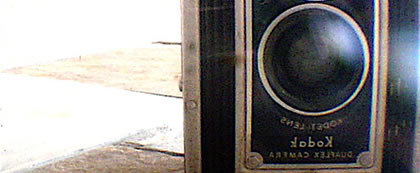
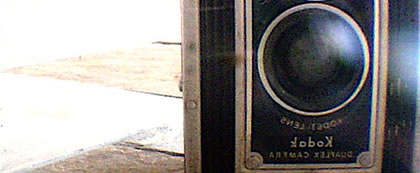
Since the rise of ever more effective technologies for recording and archiving moments in our lives, the present moment is dying. Photography is a good example. Everyone has been to a party where there's someone flitting around in the background with their camera while never really taking part in what is going on. We've all done it in one way or another. Holiday-makers spend all their time taking photos; documenting every meal, building and beach as though for a museum exhibition. Why? What for? Well the reasoning appears sound enough: I want a keepsake. But there's one thing that current technology cannot capture: our emotional states. And our emotional states are important. They are what make us human.
An emotional animal
For thousands of years we have thought ourselves largely rational beasts, occasionally beset by emotional outbursts, but ultimately still relying on logic and reason to survive. For decades cognitive psychologists have implicitly supported this picture by producing reams of research about thought processes. How we solve problems, what we pay attention to, how our brains build the waves of data from our senses into our realities.
That has begun to change. Psychological research is now suggesting a quite different picture. Our emotions are constantly interacting with our thoughts. One recent example discussed here is the effect of emotions on our perception. A study found our perception of visual contrast can improve in fearful situations. Emotion can actually improve your eyesight. This is only one of many examples that include everything from relatively minor effects on our attention to moulding our whole experience of the world.
Recording culture
To understand what this might mean for our recording culture think back twenty generations. Two hundred years ago music only existed in that one moment: when it was played. After that it was gone. It didn't matter if you went to a concert, or sat down to listen to a friend play the violin. However good the musician, it would only be played exactly that way once. Two hundred years ago if someone played, you listened. Carefully.
Back in the present our lives are quite different. Recording technology allows us to listen again and again to our favourite music, pause movies while we make tea and, of course, freeze those precious holiday moments in two-dimensional form. It's only natural for us to feel the past can be electronically captured and carried into the future.
But recording technologies are only a poor substitute for reality. Looking at a photograph helps bring back thoughts and feelings from when the image was taken. That's why looking at someone else's photographs is often such a tedious activity. There are no thoughts or feelings attached to these pictures, there is nothing but the image itself. What if we sail through our own lives without paying attention to our thoughts and feelings? When we look back on today, yesterday, last year, what do we remember?
Whether we realise it or not, our emotions are continually operating to affect the way we see the world. This is happening even when we don't specifically feel any emotions. A recording can never match the experience of being fully present: something our culture does not often recognise.
Mindfulness
Eastern philosophies have long recognised the importance of living in the moment. Buddhism teaches a way of life called 'mindfulness' which is essentially a way of battling the continuing obsession for both the past and the future to the detriment of the present. While Buddhist learning is certainly important and has much to teach us, it is difficult to understand in the Western world simply because our cultural history has moulded our consciousness in a different manner.
Instead we look to science to explain our lives. Explanations of our daily malaises need to be described to us in terms we Westerners can understand. Unfortunately, when compared to philosophy, modern science, especially psychology, has had little time to provide evidence for the kind of universal insight already available in Buddhist teachings. This is probably why ideas such as mindfulness are becoming fashionable despite scientific psychology still retaining a relatively cool attitude.
Live rather than record
The recording culture is only one facet of modern life, although in many ways it is so pervasive that it provides the perfect metaphor. Is it marketing that's turned us into such freaks for recording? The fetishisation of technology has certainly helped but these are only manifestations. It has more to do with the age we live in. We are continually bypassing the present in favour of imagined futures or the lives of others. Time is converted to money to be 'spent' at a later date. Millions watch 'reality TV' which no more represents their reality than a stranger's holiday snaps.
So take pictures, record videos, watch reality TV but don't forget life is for the living, emotionally, not for recording. Be warned though: really living is much harder work than simply recording and watching.
For a more academic treatment of the emotions, follow my search for emotional truth from the start.


Join 22301 readers


While I appreciate the basic idea—stay mindful and aware of the world around you—I think your basic assumption may be flawed. I'm an amateur musician and have been for decades, and I pay very careful attention to music both live and recorded; my iPod nano goes with me everywhere, and rather than making me less attentive to music, I can listen repeatedly and deeply. Even in pieces I have been listen to for years, I still hear things that I did not notice before.
Professionally I teach film and literature. Technology has revolutionized the viewing of film, as often for the better as for the worse: film critics, for example, are much more accurate now than they were before the VCR, when it wasn't unusual to find an article about a film that contained glaring errors about the plot. If I am writing about a scene in a film, I'll watch it in slow motion, at double speed, with the sound off, again and again. I'd also point out that the claim that people "really listened" before modern technology intervened isn't historically accurate--both concert halls and movie theaters used to be noisier, busier places, where some chitchat with your neighbor was perfectly normal. The silent concert hall is a modern invention, one that was encouraged by recording technology (it also encouraged an expectation of technically flawless playing).
Finally, if you were to make the same kind of claim about literature, it wouldn't make sense--although Plato felt precisely that writing would destroy the live performance of poetry, and our "mindfulness" and memory of it. I don't think we'd be better off without the written word, nor do I think it made us less "mindful" of our world. Quite the contrary.
Thanks for your comment Aldo.
I'm trying to pull out some broad generalisations here about our culture - always dangerous as exceptions are inevitable. You've drawn attention to two classes of people who probably don't have the average person's relationship with music and film: musicians and film critics. I would suggest other people are not quite as attentive.
I certainly wouldn't want to live without recording technologies, but we have to be aware what they might be doing to us and what they represent.
People have been recording their experiences long before the advent of evil modern technology. Is it different to blog than write in a journal? Different to take a photograph than make a sketch?
Regarding emotions and our need to pay attention to them, I have found that people, especially men are alexithymic (struggle to identify their emotions). I run therapy groups where the participants are asked to check in with their current feelings. It is amazing how hard that is for people to do, even after having been in the group for many months! They will say, I feel "good, tired, okay" which are not real emotional states. Maybe our fast paced lives is what makes it so hard for us to even identify what we are feeling.
Michelle, I'm not saying modern technology is evil - here I am blogging away on my laptop etc.. Also, there are simple qualitative differences between making a sketch and taking a picture. How long does it take to make a sketch compared to drawing a picture? How much skill does each require?
Dr Fox, yes, absolutely!
Though i agree mostly with what aldo said. It begs the question, while you take your Nano with you everywhere and listen intently, are you as aware of the scene unfolding around or are you isolating yourself from the present landscape and people in it by listening to something from the past?
I like to say that the reputed 10% of our brains (thinking,seeing, hearing) that we use is because we don't know how to pay proper attention to the other 90% of our brains (tasting, touching and kinesthesias). I suspect that this has gotten worse in modern times, for as I look at Thomas Pynchon's imitation of prior writing in Mason and Dixon, there is abundant emotion eloquently expressed. Certainly the over thinking and the Descartian error (I think, therefore I am) have swayed our populace.
But also, in truth, by my best understanding of languagwes (and someone please correct me if I am wrong) we have never really understood emotions until the dawning realizations of present day. Until 1867, when William James (United States) and James Lange (Great Britain) needed a aterm to describe what they were researching, there was no word (again, as far as I know...) for the grand category we now call "emotion." The word itself was lifted from the French, but there it meant only pathos.
Sharon Gerstenzang, Ph.D.
author of a Unified Theory of Emotion
Good article.
I googled "psychology of taking pictures" a day after attending a huge graduation ceremony at the also huge Riverside Church in New York City. The event was dominated not by the several articulate speakers, the 2000 graduates themselves, nor even by the resonant chords of the magnificent organ, but rather by the frenzy of many attendees recording the procedings with cameras (the length of rocket launchers) and video equipment.
A family in front of me spent the entire two hour ceremony examining, discussing and fiddling with its equipment. That is when one of them was not leaping out of the row for a new angle on God knows what. At several points the long aisle separating graduates from the parents, friends, etc. was entirely filled with a phalanx of amateur photographers and video cams. Not only were none of these people paying attention to the actual event at which they were present, their intrusiveness had the same effect on at least some of us who were aiming at experiencing rather than recording. I saw nothing in the people around me to suggest that people could record and experience.
I don't know what all this means, but it seems unhealthy if not, in some cases, a perverse effort to control reality instead of join with it.
Galen Tinder
Galen, great example - it's exactly this type of experience that inspired me to write this post in the first place. Much of the effort people are making to record is probably motivated by justifying the expensive equipment they've bought.