
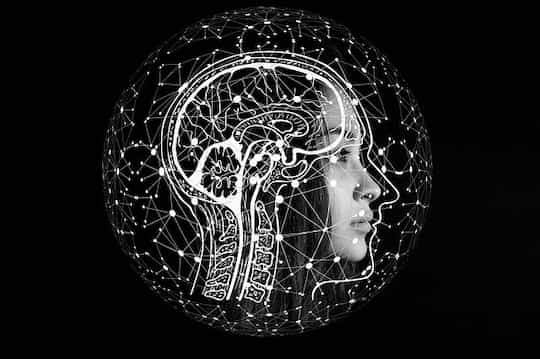
Seriously, Would You Admit to Only Using 10% of Your Brain?

Mind-myth 1: Like many of the myths now seemingly fuelled by New Agers hoping to unlock the untapped, hidden forces that will unleash previously unimagined human potential, the 10% myth is a slippery customer.
Just when all the evidence has been marshalled against its original incarnation, showing that, yes, actually we do physically use all our brains, it turns out 'human potential' can't be measured empirically. Apparently the unused 90% is hidden below the surface, out of sight and almost out of mind. Which is convenient.
Let's start at the start.
The idea that we only use 10% of our brains is probably such an enduring myth because it's comforting to think we have spare capacity. The 'unused' 90% could take up the slack after brain injury or offer the possibility for miraculous self-improvement. This flexible factoid has been used not only to sell products to enhance our brain's performance, but also by psychics like Yuri Geller to explain mystical cutlery bending powers.
Boring, tedious, but unavoidable facts
Unfortunately there's four good reasons it's almost certainly false (Beyerstein, 1999):
- If we only use 10% of our brains then damage to some parts of our brains should have no effect on us. As any neurologist will tell you, this is patently not true.
- From an evolutionary perspective it is highly unlikely we developed a resource-guzzling organ, of which we only use 10%.
- Brain imaging such as CAT, PET and fMRI shows that even while asleep there aren't any areas of our brain that completely 'switch off'.
- Parts of the body that aren't used soon shrivel and die. Same goes for the brain. Any neurons we weren't using would soon shrivel and die.
The structure of the brain and its metabolic processes have also been carefully examined, along with the diseases that afflict it. None of this work has suggested there is a hidden 90% that we're not using. Unfortunately.
Anyone who still maintains we only use 10% of our brains after this fusillade of fact has to come up with a counter-argument for each one of these. Actually, you might argue that imaging technology is rubbish or the neurons are only working at 10% capacity, but refuting all four, taken together? Now that's tricky.
Mythical roots
The roots of this myth are very difficult to discern, probably because there are so many different, diffuse stories about its origin. One probably apocryphal story is that Einstein once explained his brilliance - compared to the rest of us mere mortals - by saying he actually used more than 10% of his brain (Wanjek, 2003). Despite probably being based on a misquote, the repeating of this story can't have hurt the myth's power.
Perhaps some of the earliest roots of the myth come from work by physiologists in the 1870s. They routinely applied electrical currents to the brain to see which muscles moved. They found that large parts of the human brain could be zapped without any corresponding bodily twitching. This led them to dub parts of the brain 'silent'. But they didn't mean silent in the sense of inactive, just that it didn't make any muscles move. Of course this didn't stop the phrase being misinterpreted.
The actual confirmed first written sightings of this myth, though, is in a 1940s advert for the book Cold Comfort Farm by Stella Gibbons (Wanjek, 2003, p.21):
"What's holding you back? Just one fact -- one scientific fact. That is all. Because, as Science says, you are using only one-tenth of your real brain-power!"
Whatever its provenance, the 10% myth is certainly a slippery customer. The reason is two-pronged: first, it's impossible to prove something doesn't exist and second, people like to believe it. If I say I've seen a Pegasus, or visited Mars, or that all our brains have huge untapped potential, you can't definitively prove me wrong. That's why, despite a few good solid blows to the head, this myth refuses to go down.
Perhaps putting it the other way around might deliver the knock-out blow. Instead of talking about the 90% of untapped potential, just ask people why they only use 10% of their brains. Would anyone seriously admit to that? I, for one, am working at maximum capacity. Well, most of the time anyway...
» Find out if any other mind-myths catch you out.
[Image credit: Clint M Chilcott]
References
Beyerstein, B. L. (1999). Pseudoscience and the brain: tuners and tonics for aspiring superhumans. In: S. Della Sala (Ed.). Mind myths: Exploring popular assumptions about the mind and brain. London: John Wiley & Sons.
Wanjek, C. (2003). Bad medicine: misconceptions and misuses revealed, from distance healing to vitamin o. London: John Wiley & Sons.

Join 22301 readers


I'm reminded of a Douglas Adams quote... after an explosion someone is in hospital and dreaming/hallucinating cabin trunks full of penguins. On coming round, she reflects that she had heard that we only use 10% of our brain but had no idea that the other 90% was used for storing penguins :)
(As this is my first comment on your blog, thought I'd say thanks for all the thought-provoking material!)
Good post. There seems to be quite a bit on the 10% myth recently, any reason for this? (Sciam Mind, for example: http://www.sciam.com/article.cfm?id=uncovering-brainscams&print=true). This same article attributes the myth to a misunderstanding of William James's writings.
Lirone, you're welcome! Good quote too - from The Long Dark Tea-Time of the Soul I think.
Michael, thanks for the link - I hadn't seen this. I did, however, come across the William James connection along with a few others which I don't mention.
Not sure why this a particularly popular topic at the moment. I think debunking these sorts of myths is always popular because it's the kind of thing that comes up in conversation and people like to argue about.
I'd mention few things I stumbled upon before.
First, it might be that 90% refer not to some parts of brain, but well-spread across entire brain. (There was evidence on non-disabled quite average man with brain mostly filled with some liquid.... I'm not sure I can find the link now, though).
Second, it's more probably that we use 10% of brain _most_ time, e.g. we almost never use entire brain at once. And that we don't use brain most of time, because it will lead to neural exhaustion.
P.S. That's just my thoughts and unproved memories, so...
P.P.S. and excuse my bad english...
Fight myth with myth. One good riposte is "well, just be grateful, because if you were using 20% of your brain at the moment, you'd be lying on the floor having an epileptic fit."
This is not original, but sadly I can't remember to whom I saw it attributed.
I think the statement should read: "we only use 10% of our brain consciously". And then it will become closer to the truth.
Regards,
Olivier.
Hi Olivier, that is just a different version of the same myth. There's no evidence that our unconscious minds are only working at 10%, just the same as there's no evidence our conscious minds only work at 10%.
If we only use 10% of our brains then damage to some parts of our brains should have no effect on us.
This statement is completely irrational. Consider a fishing net, 1000 sq.ft. in size. Cut a 10 sq.ft. hole in that net.
This mere 1% change to the net's overall integrity will have a drastic effect on your haul.
Brain imaging such as CAT, PET and fMRI shows that even while asleep there aren't any areas of our brain that completely 'switch off'.
Another creative interpretation of scientific fact.
Instead of the fishing net, consider the pipelined architecture of modern CPUs. If you disable pipelining and measure its performance from the outside, using equipment of comparable accuracy and precision to an fMRI machine, you will find that no areas are "switched off". Then turn on pipelining, and measure again. Still, no areas are "switched off", yet its performance has improved.
How is this possible? It's a combination of measurement error and faulty interpretation.
"Facts" #2 and #4 have their own problems.
Let's get our own house in order, before we start picking on those silly New Agers. ;)
Thanks for the great and motivating post! I fully agree with you. Do check out http://www.subconscious-mind.org, they have a whole host of interesting and helpful articles.
I'd always assumed that the whole 'only use 10%' thing actually meant that you only used 10% at one time. So you would use all of your brain, just not all at once.
Hi Jeremy,
Yes, i think this is a myth. Or perhaps it is due to translation error, whatever.
I read it somewhere before that only 10% of our brain is active at any given time when scanned with MRI, depending on the activity we are doing.
For example, when we are talking, the neuron activities will 'light up' in the language region in our brain and the rest of the brain will go inactive temporary. Then when we switch task, let's say - solving maths, then the language region will go inactive and the logic region will go active instead.
Our brain is functioning this way to prevent process overload. I think we could go crazy if all the regions in our brain light up at the same time. Perhaps this is the same reason why human being can't really multitask, let's say doing 10 things at the same time. We could usually only focus on one or two tasks at any given time. For example, we can't talk and listen simultaneously.
So, yes, the usage of 10% of our brain is not entirely wrong, rather i believe it was a misconception.
Anyway, i thought your blog has some pretty informative content recently. Nice to read them. Keep it up. :)
Chris, with the fishing net analogy I think you're saying that the bits we 'don't use' might be spread evenly throughout the brain. There's no evidence for that either. (Hoverhell, this is your point as well).
With the CPU analogy you're assuming parts of our brains are switched off. What, sometimes? In some people? Just when they get in a brain scanner?
Remember that you can't prove something doesn't exist. Where is the evidence for us only using 10% of our brains?
Ian, like it!
Rob, Yeo Zhiyuan, these are both creative interpretations of exactly the same myth.
Jeremy, I am making no assumption about when or whether parts of the brain are switched off. I am pointing out that the measurement equipment we have today is too crude to gather any useful evidence at all.
"You can't prove I'm wrong" is not science, whether coming from New-Agers or their opponents.
Chris, apologies if I didn't make myself clear. I meant that anyone who wants to support the idea that we only use 10% of our brains needs to provide some concrete evidence.
Point taken about fMRI etc. Compared to future imaging technologies, it is probably relatively crude.
It is 10% by weight. The neurons are only a small part of the brain. Like the rest of body a majority of the brain is Water. Blood, vessels, waste removal, etc. add more. So you can you only use 10% of your brain, but if you took out the water it wouldn't work either.
dr Howard