
Experiences Beat Possessions: Why Materialism Causes Unhappiness

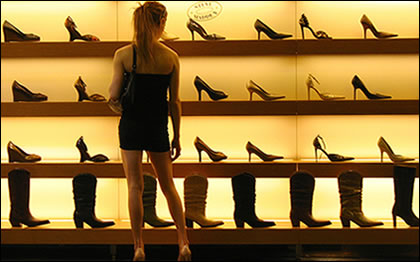
Shoe Shopping

Materialism is a dirty word. It also gets a bad rap in psychology. Studies consistently show that people who agree with statements like "You will buy things just because you want them," tend to be:

  • Less satisfied with life,
  • Less happy,
  • More likely to be depressed,
  • More likely to be paranoid,
  • More likely to be narcissistic.

Not a pretty picture, right?

But, just like studies examining the connection between success and happiness, many of the findings are correlational. As a result we can't say for sure that materialism causes all these things, only that they're associated. So, for better evidence, cue the experiment.

Experiential versus material purchases

Leaf Van Boven from the University of Colorado and Thomas Gilovich from Cornell University carried out an intriguing experiment that gets at this question of whether materialism results in less happiness (Van Boven & Gilovich, 2003).

They randomly divided students into two groups and gave each group slightly different instructions:

  1. This group was asked to write a description of a material purchase that had made them happy. Material purchases include things like clothing, gadgets, computers and so on. This could be either something they had bought themselves or that had been bought for them.
  2. The task this group had was only slightly different. They were asked to write a description of an experiential purchase that had given them pleasure. Examples of experiential purchases are meals out, admission tickets to concerts and travel.

To see how they were feeling in the moment, participants were given surreptitious measures both before and after writing these short descriptions. Then, after about a week, the same participants were given back their own descriptions of their purchases and asked to reflect on it. Again, they were asked to report on their feelings in the moment.

Comparing these two groups provided a way of comparing how participants felt about two different types of purchases. The results showed that participants felt better when they were contemplating their experiential purchases than their material purchases.

Thinking about experience

As a result of this experiment, Van Boven & Gilovich predicted that people spend more time overall contemplating their experiential rather than material purchases. To test this out they asked participants to think about experiential and material purchases they were particularly happy with. Then they were asked which they thought about more often. The results clearly showed it was the experiential purchases people thought about more often (83%).

Why do experiences fare better than possessions?

It seems, then, that at some level we understand that our experiential purchases give us more pleasure than our material purchases. But why is that? Van Boven (2005) suggests three reasons:

1. Experiences improve with time (possessions don't).
The reason why experiences improve with time may be because it is possible to think about experiences in a more abstract manner than possessions. For example if you think back to a fantastic summer from your youth, you might easily remember an abstract sense of warm sunshine and exuberance, but you're less likely to remember exactly what you did day-by-day. On a moment-by-moment basis you might have been quite bored, although you'll tend not to remember that.

Material possessions are harder to think about in an abstract sense. The car you bought is still a car, that great new jacket you picked up cheap is still just a jacket. It's more likely the experience of that summer has taken on a symbolic meaning that can live longer in your memory than a possession.

2. Experiences are resistant to unfavourable comparisons
It's well established that social comparisons can have a huge effect on how we view what might seem like positive events. One striking example is the finding that people prefer to earn $50,000 a year while everyone else earns $25,000, instead of earning $100,000 themselves and having other people earn $200,000 (Solnick & Hemenway, 1998).

In other words it's not about how much we earn, it's about how much we earn in comparison to other people. It's the social comparison, then, not the actual amount of money, that affects how we feel about our earnings.

A similar effect is seen for possessions. When there's so many flatscreen HD TVs to choose from, it's easy to make unfavourable comparisons between our choice and the others available (check out Barry Schwartz on why too much choice is bad for us).

Experience, however, seems to be more resistant to these sorts of unfavourable comparisons. To explain this phenomenon, Van Boven puts forward the idea that it is because of the unique nature of experience. It's more difficult to make an unfavourable comparison when there is nothing directly comparable. After all, each of our youthful summers is different (even if only a little).

I also think it's hard to really compare our own experiences with those of other people. Comparing possessions, however, is generally easy.

3. Experiences have more social value
There are two reasons experiences have more social value than possessions. First, experiences tend to encourage social relationships and increased social relationships are good for our happiness. Second, it is more socially acceptable to discuss our experiences with others. People who bang on about their possessions are considered much less likeable than those who talk about their holiday adventures.

Limitations

Of course, it has to be acknowledged that this type of research is at an early stage. Van Boven points to a couple of potential problems yet to be investigated:

  1. The experiments examined here looked at short-term emotions - will these short-term emotions add up to long-term happiness?
  2. Highly materialistic people might actually get more pleasure out of material purchases than experiences.

Materialist dilemmas

Despite these limitations, it seems that along with experimental evidence, there are also some good psychological reasons why experiences are more likely to make us happy than material possessions. On top of this, at some level we do seem to understand that experiences probably beat possessions in terms of happiness.

Set against this is the fact that we clearly live in a society awash with materialism, where objects are valued way beyond their possible contribution to our happiness. So how can this conflict possibly be resolved?

One answer to this question is that while we're likely to think that other people are materialist, we defend our own purchases as necessary and at worst, indulgent. After all, materialism is a dirty word. A dirty word that's on everyone's minds.

» Discover more articles in this series on the new science of happiness.

[Image credit: Orin Optiglot]

References

Solnick, S.J., & Hemenway, D.(1998). Is more always better? A survey on positional concerns. Journal of Economic Behavior and Organization, 37, 373-383.

Van Boven, L. (2005) Experientialism, Materialism, and the Pursuit of Happiness. Review of General Psychology, 9, 132-142.

Van Boven, L., & Gilovich, T. (2003). To do or to have? That is the question. Journal of Personality and Social Psychology, 85, 1193-1202.


  • Share/Bookmark

10 comments

  1. Chris Marshall | Martial Development says:

    One striking example is the finding that people prefer to earn $50,000 a year while everyone else earns $25,000, instead of earning $100,000 themselves and having other people earn $200,000 (Solnick & Hemenway, 1998).

    That makes sense to me. As money has no intrinsic value, wouldn't the $100K earner find himself priced out of every market due to forces of supply and demand?

  2. Jeremy (PsyBlog author) says:

    Hi Chris, in that study participants are told that the market remains constant across both examples. So they really are choosing half as much income in real terms.

  3. VaKraVaK says:

    This is a great website...

    But, when you say:
    Less satisfied with life,
    Less happy,
    More likely to be depressed,
    More likely to be paranoid,
    More likely to be narcissistic.

    Not all of these are can be considered "bad." Worrying about these is merely a "middle-class" occupation i.e., related to how much money one has.

  4. Jenny says:

    Why do so many psych studies exist in such a vacuum? Almost as if they need to be cultural anthropologists. The culture these study subjects came, for example- colleges students. What sort of material purchases do college students typically make? The study mentioned gadgets, frivolous things.
    Likely I'm a big old materialist but what about when materialism and experiential blends somewhat?

    My expensive chef's knife makes me happy every day as I use it.I no longer have sore hands from using a crappy knife when I chop 10 or 15 pounds of fruit for jam. And yes, I do this. I also cook daily, I never use processed foods at all.

    My Montrail hiking boots make me happy daily when I'm on a hiking trail. My feet and knees don't hurt and those boots take me places and keep my feet warm. Not sure Mario Blahnik pumps would have the same bang for the buck.

    A friend who farms loves her new tractor.
    Another friend who is a dog musher loves his new sled, also his winter gear- spending money on these things has saved his life on the trail.
    Experiential? Materialistic? Gee. Maybe I'm justifying materialism. These items are purchases of 'things' but they have fundamental practical use and make life easier and safer. If materialism purely.. then it seems materialism in these cases is the gift that keeps on giving.
    It would be interesting to see the study broadened to other age groups. Also to see it broadened to people who do more than purchase computers and flat screen TVs, gadgets and clothes.

  5. Anonymous says:

    I believe Chris is arguing that there's nothing particularly striking at all about the study's premise. And I would go as far as to suggest that the following is, arguably, a fallacious conclusion from the study which overlooks the basic economic laws & common sense understanding involved in the scenario:

    "...it's not about how much we earn, it's about how much we earn in comparison to other people. It's the social comparison, then, not the actual amount of money, that affects how we feel about our earnings."

    If greater emphasis had been placed on the relative or comparative sums involved rather than on the actual sums involved being indicative of social rather than (as I argue) economic comparison, then the study might have reached a conclusion which was far more commonsensical. Without taking account of the economic understandings of money in an exchange driven economy, one ignores the fact that money is the ultimate token of value exchange, and that in any realistic scenario where one earns half that of the average earner, one's spending power is reduced comparatively. It makes perfect common sense, in other words, to accept a lesser sum where such a sum is twice that of the average wage. The study overstates the social comparison role, as it overlooks participants' common sense reasoning as to how the value of money is derived – that is from its scarcity – and anything else just leads to inflation. More paper does not of necessity equal better paper: look no further than Zimbabwe to see evidence of same! In an attempt to sidestep this fundamental problem, those in the study where asked not only to suspend their belief in how money derives its value but to believe that the market value of money remained constant in both scenarios ; that is to say, that the 100,000 (being half of the average wage) really had twice the spending power of the 50,000 (which was twice that of the average wage). However, is that not akin to asking someone to believe in a paradox? I would submit that not only was such a paradoxical premise but it thereby asked too much suspension of participants' rational expectations as to the value of money. It was the paradoxical impossibility of suggesting that the market value of goods, services etc. could possibly remain constant in both scenarios given that - in accordance with the basic laws of economics - such would be an impossibility. One of the main issues which participants would ordinarily have had to consider was the inflationary pressures to which one would be subject. Furthermore, even if the value of one's money remained constant in both scenarios and thereto defied the basic laws of economics, there is the ever present risk that the normal laws of economics would soon 'catch up' with a participant who accepted more actual money than in the first scenario, but which was half the average wage. What guarantee could there possibly have been that that wouldn't have happened after one received one's wage, even if at the time of accepting one's wage the normal laws of economics were subverted? It would have been appropriate if those conducting the study just looked at the value received rather than the sums received. Thus to receive double the average value is far better than to receive half the average value; and asking participants to believe otherwise led to the arguably false conclusions of this study: it's not so much about social comparisons that persons chose to earn a lesser sum which was twice that of average, it's more, arguably, to do with the fact that participant's are acting rationally; that is to say, in accordance with their rational expectations of how a market should realistically operate. Concluding otherwise was, it is submitted, to underestimate the common sense economic reasoning which participants should have been expected to employ. (TW, London)

  6. Jenny says:

    "One answer to this question is that while we're likely to think that other people are materialist, we defend our own purchases as necessary and at worst, indulgent. After all, materialism is a dirty word. A dirty word that's on everyone's minds."

    Well.. on my past comment, doubtless I am defending my own materialism as necessary :-D

    The author also states that it is difficult to view objects such as a car in an abstract sense.

    IMHO here is where the materialistic and the experiential blend. To a person without a car, or to perhaps an elderly person who loses their capacity to drive- well, a car is abstract indeed, it symbolizes freedom, autonomy.

    Money itself won't make people happy, of course, but money if used intelligently, can improve lives- education, travel.. and yes, some well considered material choices. If I spend money on a kayak I don't spend money on the kayak to sit and admire it. I buy it because it opens worlds to me. That sounds pretty experiential to me.

    If I go out to dinner with friends.. actually, I don't get scads of pleasure from this sort of experience. Kayaking with a friend? Now, that rocks. But how do I do it without the kayak?

    The focus of this study still seems narrow because of the types of purchases it focuses on, and the subjects (students).

  7. telephone snow says:

    Jenny - the way you're using materialistic purchases that make you happy make me think that your purchases would best be described as "experiential accessories" or "tools to make great experiences" than materialistic purchases. It's hard to make that distinction, and while reading the article, I thought, "But that dress I bought helped me to feel really fancy when I went to the opera. And that record player I got at a garage sale years ago has changed my life, basically."

    So where does one draw the line between materialistic and experiential accessory? Hard to tell.

  8. Lilly says:

    I loved reading this experiment, but I must admit that I had much the same reaction as the Jenny poster. But having now re-read the experiment outline, I have a question.

    The study outline says that the groups were asked to write a description of their "material purchases" and their "experiential purchases." What I wonder is whether the people who bought things like a new poster frame, or ski boots were more likely to end up writing -about- the experience of purchasing it, or the novelty of finding the object and having the feeling of 'having' to buy it, which has since worn off (they have seen so many other objects) and thus have not triggered the same sense of -user- and -owner- experiential satisfaction of their purchases in their description. Ex. I love my new winter coat, its stylish, when I saw it I just had to have it. When I first saw it I thought it was the greatest color, there was that buyers rush. But there is another facet of the purchase, the wool doesn't make me breakout, I have yet to see such a quality item on sale, I have not caught cold this season, I have received compliments, the sleeves don't scratch my wrists, I actually feel warm outside. I am happy in the coat. But somehow those feelings aren't tapped into with the question asked about the purchase. Whereas opera tickets that I bought make me immediately think of the lovely evening I had a while back.

    My point is that I think there is another reason why experience fare better than possessions in this study: thinking about buying the 'wool coat' is just like buying the opera 'ticket' and 'experiencing' the coat (wearing, washing, using) is equal to going to the opera.

    Now assuming that the wording wasn't bias when people were asked to describe their purchases, and people just naturally made the distinction between describing the object in the one case and the experience in the other (which I am completely willing to believe) then the distinction is being made by the subjects and the conclusions are valid. That is, asking someone about an object's purchase does not trigger them to evaluate the experiences it provides. I.e. the ability to kayak with great pleasure, avoid catching cold by owning a new coat, etc.

    There are a couple inevitable cross overs I wonder about though, what of books & films? Is it an object or an experience? Can one separate out the experience from the object? Sounds like a new experiment to me...

    All in all, I still like this experiment.

  9. Jeremy (PsyBlog author) says:

    Thanks for all your comments. Just one general point I'd like to make. Experiential and material purchases are clearly not entirely separate categories. What the experiment is trying to do is get people to focus on one purchase that is more experiential and one that is more material. The experimenters expected that on average over all the people involved in the study this would yield a significant difference between the groups.

  10. Laura New says:

    I have siblings that can afford to buy wonderful "experiences": vacation trips to Europe, week-long retreats to the mountains. I do not have the money for such things and miss it, even more so because I get to hear all about how wonderful they are from my siblings.
    This relates to the article in two ways:
    1. I don't see how paying for a wonderful experience is less "materialistic" than paying for a big screen TV to spend evenings watching movies on. To me it's all the same, and I wish I had the money.
    2. And not having those things would probably be a lot easier if those around me weren't always buying them. So I'd definitely prefer having more money then the people around me to having less than those around me, even if in making that choice I wound up with a lower 'number of dollars' overall.

» Comments are now closed on this post «

Archives