
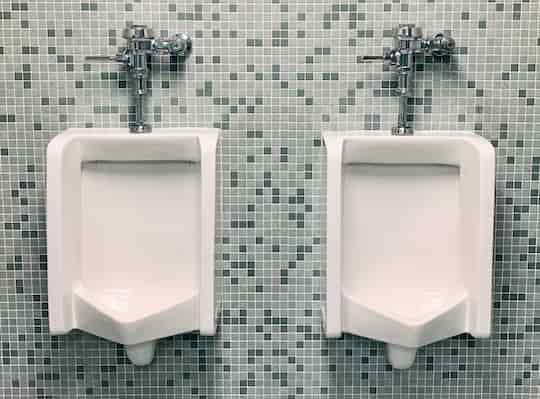
Don’t Stand So Close to Me

Urinals

[Photo by Phil Dokas]

Here's a weird study that sometimes gets a mention in ethical discussions about psychology, and it's not hard to see why. Middlemist, Knowles & Matter (1976) designed an experiment to test how the speed and flow of men's urination in a public lavatory was affected by invasions of personal space.

Piss pilot
To gather some preliminary data on men's toilet habits, a pilot study stationed an observer in a public toilet at a US university. He was instructed to look like he was grooming himself in the mirror, but was actually keeping a record of which urinals men stood at and their patterns of urination.

Timing them on his wristwatch, our intrepid toilet researcher measured the onset delay in micturation along with persistence of flow. If you're wondering how our correspondent measured these, it was by sound - which must have been no mean feat when there was multiple micturation in progress.

Sure enough the pilot study revealed men prefer not to stand next to each other in the urinals, and the closer other men are to each other, the longer it takes for them to begin urinating, and the shorter the persistence of their stream.

And now for the periscope...
Middlemist et al. were not satisfied with this observational data, however, and decided to carry out a proper experiment. For this they required a more complicated setup, and a little covert action.

They forced unknowing urinators to spend their pennies in one (out of three) urinals that was closest to a single stall. A confederate (who was in on the experiment) then either stood directly next to the various experimental subjects, one urinal away, or was not present at all.

Hidden in the stall was our urine measurement officer (grad students get all the best jobs). Chief amongst his weapons was a specially designed periscope hidden in a stack of books so that the stream of urine could be directly observed.

The experimental version of the pilot study confirmed earlier findings. With no one present, unselfconscious urinators' average onset was 4.8 seconds, with a confederate present one urinal away, mildly self-conscious urinators' average micturation onset was pushed up to 6.2 seconds. Finally with the confederate in the next urinal, it was 8.4 seconds before our bashful toilet-goer's blessed relief began.

Urination and personality?
Rather than being left with the feeling, as you may be, that this was not only distasteful but also a bit of a waste of time, the psychologist in me comes out. I'm wondering about personality correlates and personal space. For example, is neuroticism positively correlated with increasing micturation onset, while extroversion is negatively correlated?

The problem is then you've got to get urinators to fill in a personality measure on the way out, which will expose all the periscope business, which in turn may lead on to a variety of uncomfortable conversations. Perhaps we'll just leave this one as it is.

» Read more weird psychology studies.

References - Click here to toggle visibility

  • Share/Bookmark

16 comments

  1. jmccance says:

    A couple thoughts. First of all, the periscope can be eliminated, as can the grad student. Rig some sort of pressure sensor to the urinal. If you use one of the self-flushing ones, you might even be able to take advantage of the sensor to detect when a "customer" arrives. If you can get good logs on all three urinals, you might even be able to get rid of the confederate and instead just tally the data based on which urinals were active.

    As for the personality test, that's admittedly trickier. Maybe hold a mock study where you come up with some excuse to give them a personality test and lots of water?

  2. Jim says:

    Very interesting; I wonder how much "abandonment of task" there was (e.g., people pretend to go; or act as if they're done, then make a beeline for a stall that opens; or abandon entirely "*cough* I have to go number two"). Or, how many men when, seeing the stack of urinals busy, waited for a stall.

  3. Todd O. says:

    I wonder if this would hold up across cultures? Is this an American thing (Americans are known to have much larger personal spaces than other cultures)? Or a "human" thing? My guess is that this is a culturally bound phenomenon.

  4. Nekomata says:

    Although I know little about psychology, I have always suspected that this must in some way be tied to the practice of most male mammals of marking territory. I've always thought this must happen because having another male "invading your territory" still registers on some subconscious, primeval level, and makes you feel uneasy.

  5. Jeremy (PsyBlog author) says:

    jmccance, you sir are hired!

    Jim, true - actually in this experiment there was only one stall, and that had the grad student in it. Perhaps we could use jmccance's idea and also rig up the stall with a pressure sensor.

    Todd, good point. Unfortunately for our grad student it means we have to send him on a tour of the world's toilets.

    Nekomata, I hadn't thought of it like that before - interesting.

  6. Anonymous says:

    For crying out loud. Guys take longer when someone is next door because they don't want to fart in public by letting loose all at once, so they've gotta ease into it. I'm serious.

  7. Anonymous says:

    Doesn't this seem like a fairly intrusive and unnecessary invasion of privacy to begin with? If this were done in a women's toilet, or by anyone other than grad students with the periscope, it would be prosecuted. It seems like a sensor system at, say, an interstate rest stop measuring flow and whether or not someone is at the porcelin would gather the same data more effeciently.
    Hey, maybe that's the real reason behind those electric eye flushers that have turned up everywhere.

  8. Jeremy (PsyBlog author) says:

    Yes, I think most ethics boards nowadays would take the view that this study is unnecessary and intrusive. But it was done in the 70s before things were tightened up.

  9. Anonymous says:

    Ha, I thought I was alone.

  10. michael mallows says:

    Jeremy,
    when you say, 'before things tightened up'....

    And, Anonymous, you are NEVER alone; BB is watching your every move, so be afraid, be very afraid!!

  11. Trev says:

    Michael ur a tool, the last Anon ment, he was alone in that he couldnt pee right away when someone was near him... idiot..

  12. crash says:

    In a decade when this will put you on a sex offender list, it may be fun to recall open urinals. As a child of the 60's, I recall the horse trough urinal where you stood hip to hip and everything hung out for all to see. Then came the individual urinal, then having partitions between urinals, and now the partitions are so high, you have no eye contact with the person next to you. It gives the feeling of being in a stall at a toilet, but with less room. I believe it may be an American hangup about penis size, and less about homophobia. Now before you scoff, let me say that I have always noted that the more endowed a man is, the less likely he would belly up to the urinal in modesty. On a final note, I miss the urinal that went to the floor, as I hate the shock when the head of my penis falls into the water.

  13. Anonymous says:

    This brings to mind a little note I saw in front of the bowl:
    STEP CLOSER, IT IS SHORTER THAN YOU MAY THINK!
    LOL

  14. EricO says:

    I don't think this is an american thing... I was once told by a Latin teacher that Romanians were having discussions while all having a poo together. I guess, if it's true, that they were not all pretending...

    I don't find this experiment especially schocking and I think it may be good for some to now that's not a personnal problem of them which prevents them from peeing next to other men. My guess is it may have been the goal of the researcher to reassure himself ^^

  15. Anonymous says:

    I had one of the authors of the study as an instructor at UW-GB.

» Comments are now closed on this post «

Archives